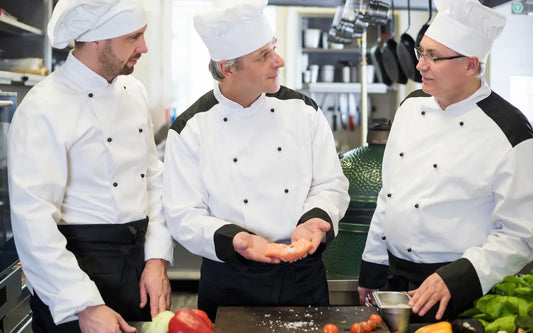
Featured Course
Food Hygiene and Safety
Build confidence in contamination prevention, cleaning, allergen control, safe storage and temperature management for everyday food operations.

The temperature danger zone is commonly described as 5°C to 63°C, where many harmful bacteria can multiply quickly. Keep chilled food at 5°C or below, hot food above 63°C, and cook to validated core limits such as 75°C, while following national law and your HACCP plan.
Temperature control is one of the most important parts of an effective food hygiene and safety system. It cannot make contaminated food safe in every circumstance, but it can prevent bacteria from multiplying, reduce survival during cooking and protect food while it is stored, displayed or transported.
The European Union does not establish one universal statutory “danger zone” covering every food and every business. Regulation (EC) No 852/2004 instead requires food businesses to maintain the cold chain and prevent food from being held at temperatures that could create a health risk. Specific limits may then come from EU product legislation, national law, official guidance, product instructions or the business’s validated HACCP controls.
At a glance:
Key takeaway: The 5°C–63°C danger zone is a practical food-safety benchmark, not a single harmonised EU legal limit.
The temperature danger zone is the range in which food-poisoning bacteria can grow relatively quickly when moisture, nutrients and other conditions are suitable. Food-safety guidance in Ireland defines this range as 5°C to 63°C. European Food Safety Authority guidance similarly advises refrigerating perishable food below 5°C and keeping food hot above 60°C when it is being served.
The difference between 60°C and 63°C illustrates why businesses must distinguish a widely used operational benchmark from a legal requirement that applies everywhere. The correct limit depends on the Member State, food type, process, shelf life and control system.
Temperature affects how quickly microorganisms can grow. Many harmful bacteria multiply particularly well at moderate and warm temperatures, although the precise growth range varies by organism and food.
Refrigeration slows bacterial growth, but it does not sterilise food. Listeria monocytogenes, for example, can persist and grow under chilled conditions, which is why low refrigerator temperatures, appropriate shelf lives and protection against post-cooking contamination remain essential.
Heating can reduce or destroy many harmful microorganisms, but its effectiveness depends on both temperature and time. A lower temperature may provide an equivalent safety effect when maintained for longer, provided the combination has been scientifically validated.
No. Regulation (EC) No 852/2004 requires food businesses to maintain temperature control and the cold chain, but it does not prescribe 5°C and 63°C as universal limits for all foods.
The Regulation allows limited periods outside temperature control for practical handling, preparation, transport, display or service, but only where this does not create a health risk. It also requires chilled food to be cooled as quickly as possible after heat processing or final preparation.

Key takeaway: Time spent at unsafe temperatures can turn a small contamination problem into a serious food-safety risk.
Temperature abuse often occurs through several small failures rather than one dramatic incident. Examples include:
The longer suitable food remains at growth-supporting temperatures, the more opportunity bacteria may have to multiply. This is why food businesses should control both how warm the food becomes and how long it remains at that temperature.
European Food Safety Authority guidance advises that cooked food should not be left at room temperature for more than two hours and should be refrigerated promptly below 5°C. The Food Safety Authority of Ireland also uses a two-hour operational limit for cooling cooked food or using food that is not being hot-held above 63°C. These are useful practical benchmarks, but businesses must follow the requirements applicable in their own jurisdiction and food-safety plan.
Key takeaway: Safe cooking depends on achieving a validated time-and-temperature combination at the coldest part of the food.
Cooking controls should be based on the core temperature, measured at the centre or thickest part of the food. Checking only the oven setting, surface colour or cooking time does not confirm that the coldest part has received adequate heat.
A commonly used catering benchmark is:
These values are included in official Irish food-business guidance. They should not be presented as a universal EU limit for every product or process. Businesses using alternative combinations should be able to demonstrate that the process achieves the required microbiological reduction.
Core checks are especially important for:
Take several readings when a batch is large or uneven. Measure the thickest or slowest-heating area without allowing the probe to touch a hot tray, bone or cooking surface.
There is no single temperature that instantly destroys every possible biological hazard in every food. Destruction depends on the organism, temperature, exposure time, food composition and starting contamination level.
For routine catering, a validated combination such as 75°C instantaneously or 70°C for two minutes is commonly used to control vegetative food-poisoning bacteria. Cooking does not, however, correct poor storage, contamination after cooking or every heat-stable hazard.
Key takeaway: Keep temperature-controlled food clearly on the cold or hot side of the business’s validated limits.
A practical target for many chilled foods is 0°C to 5°C. Refrigeration equipment may need to be set at approximately 3°C or 4°C so the food itself remains at or below 5°C during normal use.
Do not assume that every food follows the same limit. Sector-specific and national legislation may require lower temperatures. Spain’s Real Decreto 1021/2022, for example, sets different retail refrigeration limits for specific products, including 2°C for minced meat, 4°C for poultry and meat preparations, and temperatures close to melting ice for certain fresh fishery products.
Irish food-business guidance requires hot-held food to remain above 63°C and recommends using food within two hours where it is not maintained above that temperature. EFSA public guidance uses above 60°C as a general safe-handling recommendation.
Hot-holding equipment should maintain the temperature of food that is already thoroughly cooked and hot. It should not normally be relied upon to reheat chilled food unless the equipment and process are specifically designed and validated for that purpose.
EU food law establishes a shared hygiene framework, while Member States may maintain additional national measures, enforcement approaches and sector-specific limits. Businesses operating in more than one country should therefore avoid copying a temperature chart from one jurisdiction into every location without checking local requirements.

Key takeaway: Cool cooked food quickly, store it safely and reheat it through the core rather than merely warming the surface.
Regulation (EC) No 852/2004 requires food intended to be held or served chilled to be cooled as quickly as possible after heat processing or final preparation. It does not prescribe one cooling time for every EU food business.
A commonly used practical procedure is to move cooked food into refrigeration within two hours. Food Safety Authority of Ireland guidance recommends cooling food quickly and placing it in the refrigerator within that period.
Reheating means bringing previously cooked food back to a safe core temperature, not making it merely warm. Irish guidance uses at least 70°C at the core and advises reheating only once. Other jurisdictions or validated processes may specify different limits.
Reheated food should be served immediately or transferred to effective hot-holding equipment. Repeated cycles of cooling and reheating increase opportunities for time-temperature abuse and contamination.
Build confidence in contamination prevention, cleaning, allergen control, safe storage and temperature management for everyday food operations.
Key takeaway: Accurate temperature checks require the correct instrument, the correct measuring point and a documented response to failures.
Use a calibrated food probe for core measurements. Infrared devices can be useful for screening surface temperatures, but they do not establish the temperature at the centre of a product.
Food Safety Authority of Ireland guidance recommends checking a probe at low temperature using crushed ice and a small amount of cold water. The stabilised reading should be approximately 0°C, within the tolerance specified by the guidance or manufacturer. Probes outside the accepted tolerance should be adjusted, professionally recalibrated or replaced.
Temperature records should be proportionate to risk. Useful records may include:
A record is valuable only when staff know what action to take after an unacceptable result.
Key takeaway: Use these figures as common operational benchmarks and confirm the legally applicable limits for your country and food process.
|
Process |
Common operational benchmark |
Practical meaning |
Important qualification |
|
Chilled storage |
0°C–5°C |
Keep high-risk chilled food cold and minimise door-opening time |
Product-specific or national limits may be lower |
|
Temperature danger zone |
5°C–63°C |
Minimise the time suitable food spends in this range |
Practical definition used in Irish guidance, not a universal EU statutory range |
|
Hot holding |
Above 63°C |
Hold already-hot food in suitable equipment |
EFSA general guidance uses above 60°C; national rules vary |
|
Cooking |
75°C instantaneously |
Measure at the core or thickest part |
A validated equivalent such as 70°C for two minutes may be used |
|
Reheating |
At least 70°C at the core |
Reheat thoroughly, not just until warm |
Follow national guidance and the validated food-safety procedure |
|
Cooling |
Refrigerate within two hours |
Divide batches and cool as quickly as possible |
Two hours is a practical guide; EU law uses a risk-based outcome |
|
Frozen storage |
–18°C or colder |
Maintain the frozen chain and monitor equipment |
Check product-specific legislation and label instructions |
The operational values above are supported by current EFSA and Food Safety Authority of Ireland guidance, while Regulation (EC) No 852/2004 remains risk-based and does not make every value universally applicable across the EU.

Key takeaway: Training should help employees understand not only the target numbers, but also how to measure, record and respond to them.
Effective temperature control depends on equipment, procedures, competent staff and management verification. Employees should understand:
Explore the four C’s of food safety, review practical food storage rules and ensure temperature procedures also prevent cross-contamination.
To build practical competence across cooking, chilling, storage and contamination control, enrol your team in Food Hygiene and Safety training.
This article provides general educational guidance rather than legal advice. National legislation, competent-authority guidance, product requirements and validated HACCP limits may impose different or additional controls.
Equip food handlers and supervisors with practical skills to support APPCC compliance and maintain safer hospitality workplaces.
Key takeaway: The article prioritises current legislation, official regulatory guidance and recognised food-hygiene standards.
This article was prepared using the target search intent, the supplied editorial brief, current official legislation and practical food-business guidance. Legal requirements were distinguished from national guidance and commonly used operational benchmarks.
Principal sources consulted: