Featured Course
Food Hygiene and Safety
Master essential food hygiene, APPCC, allergen control, temperature management and inspection-ready practices for Spain and the EU.

The 4 C’s of food safety are Cleaning, Cooking, Chilling and Cross-contamination. Together, they prevent the main routes by which food becomes unsafe: dirty hands and surfaces, undercooking, uncontrolled temperatures, and transfer from raw food or contaminated equipment to ready-to-eat food. They support the hygiene controls required by Regulation (EC) No 852/2004.
The four Cs turn food hygiene into four operational questions: Is the workplace clean? Has the food been cooked safely? Is temperature controlled? Can contamination move between food, people, surfaces or equipment?
The framework supports—but does not replace—a documented food safety system. Regulation (EC) No 852/2004 requires hygienic premises, contamination prevention, temperature control where necessary, staff training and supervision, and HACCP-based procedures. “The 4 Cs” is a training framework, not a legal term in the Regulation.
Key takeaway: The four Cs organise everyday food-safety controls into Cleaning, Cooking, Chilling and Cross-contamination prevention.
Cleaning removes food residue, dirt and contamination from hands, equipment and food-contact surfaces. Cooking uses a validated time-and-temperature process to reduce harmful microorganisms. Chilling limits microbial growth by controlling cold storage and cooling. Cross-contamination prevention stops hazards moving from raw food, people, equipment or the environment to other food.
The Codex Alimentarius General Principles of Food Hygiene defines food hygiene as the conditions and measures needed to keep food safe and suitable throughout the food chain. It treats cleaning, temperature control, hygienic storage, staff competence and prevention of cross-contamination as connected controls. For the system-level overview, see food hygiene and safety.
A failure in one C can undermine the others: cooked food can be recontaminated on a dirty tray, while colour coding fails when separation procedures are ignored.

Key takeaway: Cleaning must remove contamination effectively, follow a defined method and be verified rather than assumed.
Cleaning procedures should match the surface, equipment and operation. Food-contact equipment must be cleanable and maintained, with disinfection used where necessary. Codex states that cleaning should remove residues and dirt that may cause contamination, including allergens, and that disinfection may be needed after cleaning, especially on food-contact surfaces.
A practical cleaning control defines what is cleaned, the approved method and chemical, dilution and contact time, responsibility, frequency, and how completion is verified.
Hand hygiene belongs within Cleaning, but it also needs its own controls. Staff should wash their hands at the points defined by the business—for example, before handling ready-to-eat food and after handling raw food, waste, dirty equipment or potential contaminants. Gloves do not replace handwashing and can themselves transfer contamination when used incorrectly. Codex specifically identifies handwashing, appropriate clothing, instruction and supervision as food-hygiene training topics.
For a deeper operational method, see cleaning and disinfection in food premises.
Key takeaway: Cooking is safe only when the chosen process reliably achieves the required control throughout the food.
Cooking can reduce harmful microorganisms, but visual appearance alone is not a dependable control. The business should define a validated time-and-temperature combination for each relevant product and process, taking account of national guidance, product specifications and its HACCP-based procedures.
The EU hygiene framework requires food businesses to control hazards and maintain the cold chain where relevant, but it does not provide one universal cooking temperature for every food and every process. The correct limit may differ according to the product, method, competent-authority guidance and validated equivalent combinations. Codex likewise expects businesses to establish relevant limits and monitor processes that affect food safety.
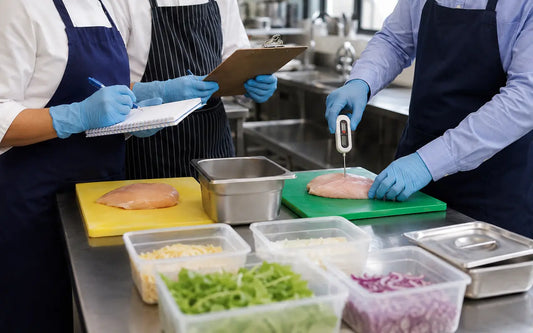
A sound cooking check uses a clean, accurate probe in the thickest or slowest-heating part of the product, avoids contact with trays or bones, records results where required, and defines corrective action when the limit is not achieved. Cooked food must then be protected from recontamination.
In the kitchens we audit, the recurring weakness is often inconsistent checking: staff probe different places, omit records or fail to clean the probe between raw and cooked products. The method must be standardised and supervised.
For detailed limits and monitoring principles, see the temperature danger zone and safe food temperatures.
Key takeaway: Chilling controls risk by keeping food within defined limits and reducing the time it spends at temperatures that permit rapid microbial growth.
Cold storage slows microbial growth; it does not make contaminated food safe. Refrigerators and freezers must be capable of achieving and maintaining the business’s required conditions, and food should be arranged so that air can circulate, contamination is prevented and staff can identify stock clearly.
Regulation (EC) No 852/2004 requires the cold chain not to be interrupted for food that cannot safely be stored at ambient temperature, subject to limited practical handling periods where this does not create a health risk. Codex requires temperature-control systems to consider the food, microorganisms, shelf life, processing and intended use, and recommends checking the accuracy of monitoring equipment.
Operational controls should cover routine temperature checks, rapid controlled cooling, refrigeration loading, labelling, raw/ready-to-eat separation, probe accuracy, equipment maintenance and clear action for out-of-limit food.
A refrigerator display shows air temperature, not necessarily food temperature. Where safety depends on temperature, staff may need an accuracy-checked probe and defined sampling method. Codex recommends monitoring and regular checks of temperature-control devices.

Key takeaway: Prevent cross-contamination by separating hazards at every stage—storage, preparation, equipment use, cleaning and staff movement.
Cross-contamination occurs when harmful microorganisms or other hazards move from one food, surface, person or item of equipment to another. It may happen through direct contact, contaminated hands or utensils, dirty cloths, droplets, packaging, poor storage order or movement between raw and ready-to-eat areas.
Regulation (EC) No 852/2004 requires food to be protected against contamination that may make it unfit or harmful, while Codex recommends layouts, workflow and storage that minimise cross-contamination. Codex also calls for segregation of raw and cooked food and, where relevant, allergenic and non-allergenic food.
Practical controls include physical separation, raw-below-ready storage, dedicated or effectively disinfected equipment, consistent colour coding, controlled staff and utensil movement, and disposal of contaminated food when safe recovery is not possible.
Colour coding is a control aid, not a legal guarantee. A red board does not prevent contamination when it is stored against clean ready-to-eat equipment or washed inadequately. The business must design the complete separation system around its actual workflow.
This article focuses on microbial cross-contamination. For the wider distinction between microbial transfer and allergen cross-contact, see cross-contamination in the kitchen.
Key takeaway: Each C needs a defined control, a checking method and corrective action when the standard is not met.
|
Cs |
Main risk controlled |
Practical controls |
Evidence or verification |
|
Cleaning |
Residues, microorganisms and contamination on hands, surfaces and equipment |
Cleaning schedule, correct chemicals, handwashing, disinfection where necessary |
Sign-off, inspection, chemical checks and risk-based verification |
|
Cooking |
Survival of harmful microorganisms |
Validated time and temperature, correct probe position, protected post-cook handling |
Temperature records, probe checks and corrective-action records |
|
Chilling |
Growth of microorganisms during storage or cooling |
Defined cold limits, rapid cooling, working refrigeration, stock protection |
Cabinet and product checks, equipment records and escalation logs |
|
Cross-contamination |
Transfer from raw food, people, tools, packaging or the environment |
Separation, storage order, dedicated equipment, controlled workflow |
Supervisory observation, hygiene inspections and non-conformance records |
The most useful management question is not “Do we know the four Cs?” but “Can we demonstrate that each control is working during a busy service?” Procedures should therefore state who checks, when they check, what acceptable performance looks like and what action follows a failure.
Master essential food hygiene, APPCC, allergen control, temperature management and inspection-ready practices for Spain and the EU.
Key takeaway: The principles are EU-wide, but numerical limits, inspection practices and sector-specific requirements can vary by country.
Regulation (EC) No 852/2004 establishes a common EU hygiene framework, while Member States and competent authorities may provide detailed national guidance or additional sector rules. The European Commission also recognises flexibility for certain establishments.
Country variations: Follow the rules and official guidance of the country in which the establishment operates. Training certificates, temperature guidance, inspection systems and some retail or catering controls are not identical across all Member States. A limit used in one country should not automatically be presented as an EU-wide legal number.
Professional limitation: This article provides general food-hygiene guidance and is not legal advice. National legislation, competent-authority instructions, sector rules, product specifications and the business’s validated HACCP controls may add or refine requirements.
Key takeaway: The four Cs are most effective when built into workflow, supervision, records and corrective action rather than taught as four isolated definitions.
A practical implementation sequence is:
Codex treats competence, supervision, monitoring and corrective action as central to an effective food hygiene system. EFSA’s role in monitoring foodborne disease and outbreaks across Europe also demonstrates why preventive controls must operate consistently throughout the food chain.

Key takeaway: Training should help staff apply the four Cs correctly in the specific food operation where they work.
Knowing the terms is only the starting point. Staff need to recognise contamination routes, follow the approved cooking and chilling controls, use cleaning chemicals correctly, complete required records and report deviations promptly.
Explore the Spanish Compliance Institute Food Hygiene and Safety course to help your team understand and apply Cleaning, Cooking, Chilling and Cross-contamination controls in day-to-day food operations.
Learn to prevent food hazards, follow safe handling procedures, maintain accurate records and protect customers in hospitality settings.
Key takeaway: This article is based on primary EU legislation, official EU information, Codex guidance and current food-safety evidence.
The article was developed from the target search intent and fact-checked against binding EU legislation, European Commission information, recognised international guidance and current authoritative sources. It distinguishes legal duties from Codex guidance and operational good practice.
Principal sources consulted: