Featured Course
Food Hygiene and Safety
Build practical skills in contamination prevention, temperature control, allergen management, workplace hygiene, and APPCC procedures.

Food hygiene and safety is the set of practices that keeps food free from contamination and safe to eat, including cleaning, cooking, chilling and preventing cross-contamination. In the EU, Regulation (EC) No 852/2004 requires food businesses to apply hygiene controls through procedures based on Hazard Analysis and Critical Control Point principles.
Professional limitation: This article provides general compliance guidance, not legal advice. Food businesses must also follow the national, regional, municipal and sector-specific requirements that apply where they operate.
Food hygiene and safety is not a single kitchen rule or training certificate. It is an operational system covering premises, equipment, suppliers, storage, preparation, temperature control, cleaning, personal hygiene, allergen controls, traceability, staff competence and management oversight.
For an EU food business, the objective is to prevent unsafe food from reaching consumers and to demonstrate that risks are being controlled consistently. Written procedures matter, but inspectors and customers ultimately depend on what happens during receiving, storage, preparation, service and corrective action.
In summary, an effective food safety system should:
Key takeaway: Food hygiene describes the conditions and practices used to protect food, while food safety is the outcome those controls are intended to achieve.
Food hygiene includes the conditions and measures needed to keep food safe and suitable throughout the food chain. Food safety is the assurance that food will not cause adverse health effects when it is prepared and consumed as intended. The terms overlap, but the distinction is useful: hygiene concerns the controls; safety concerns the result.
|
Concept |
Practical meaning |
Examples |
|
Food hygiene |
The conditions and working practices used to prevent contamination and deterioration |
Handwashing, cleaning, pest control, separation, temperature control |
|
Food safety |
The condition in which food will not cause harm when used as intended |
Food free from unacceptable microbial, chemical, physical or allergenic risk |
|
Food safety management |
The organised system used to select, monitor and verify controls |
Good Hygiene Practices, HACCP-based procedures, records, supervision and review |
|
Food suitability |
Food being acceptable for human consumption, including freedom from spoilage or objectionable contamination |
Correct storage, stock rotation, packaging integrity and quality checks |
Regulation (EC) No 852/2004 establishes general hygiene rules for food business operators and places primary responsibility for food safety on the business. It applies alongside the broader principles of Regulation (EC) No 178/2002, while Regulation (EC) No 853/2004 adds specific requirements for many foods of animal origin.
A fridge temperature check cannot compensate for poor supplier controls. A cleaning schedule cannot prevent contamination if raw poultry is prepared beside ready-to-eat salad. Staff training will not remain effective if managers tolerate shortcuts during busy periods.
The strongest systems connect:
The European Commission’s guidance on food safety management systems explains the relationship between Good Hygiene Practices and procedures based on Hazard Analysis and Critical Control Point principles. Codex Alimentarius CXC 1-1969 provides the internationally recognised framework for this relationship.
For a dedicated explanation of the legal framework, see EU Food Hygiene Regulations Explained. For a deeper treatment of HACCP methodology, use What Is HACCP? The Complete Beginner's Guide to the 7 Principles.

Key takeaway: Food hygiene controls protect consumers, reduce disruption and give a business evidence that it is managing foreseeable risks.
Foodborne disease remains a significant public-health issue. The European Food Safety Authority and European Centre for Disease Prevention and Control reported 6,558 foodborne outbreaks in Europe in 2024, involving 62,481 reported human cases, 3,336 hospitalisations and 53 deaths. Campylobacteriosis and salmonellosis remained the two most frequently reported zoonoses, while listeriosis was less common but particularly severe.
These figures represent reported outbreaks and cases rather than every illness occurring in the community. They nevertheless show why food safety management cannot be reduced to visible cleanliness. Food may look, smell and taste normal while containing harmful microorganisms, undeclared allergens or chemical contaminants.
Poor control can lead to:
Ready-to-eat foods that support microbial growth require particularly careful control because they may receive no further cooking before consumption. Examples can include cooked meat, dairy products, prepared salads, cooked rice, shellfish and certain egg products.
The risk depends on the food’s formulation, processing, storage conditions, shelf life and intended consumer. Hospitals, care settings, nurseries and businesses serving older people, pregnant consumers or people with reduced immunity may need stricter operational controls.
Read the dedicated guides to foodborne illness, its causes and prevention and high-risk foods and safe handling for more detailed risk profiles.
Build practical skills in contamination prevention, temperature control, allergen management, workplace hygiene, and APPCC procedures.
Key takeaway: Cleaning, Cooking, Chilling and Cross-contamination control provide a practical framework for the everyday activities most likely to affect food safety.
The 4 C’s of food safety are Cleaning, Cooking, Chilling and Cross-contamination. They are a teaching and implementation framework rather than the formal wording of Regulation 852/2004, but they translate core hygiene duties into actions that staff can understand and supervisors can check.
|
Control |
Main objective |
Practical controls |
Useful evidence |
|
Cleaning |
Remove food residue, dirt and microorganisms from hands, equipment and premises |
Documented schedules, correct products, dilution, contact time, clean-as-you-go procedures |
Cleaning records, product instructions, verification checks |
|
Cooking |
Apply sufficient heat to reduce harmful microorganisms to an acceptable level |
Validated time-and-temperature combination, core-temperature checks, standard recipes |
Cooking records, probe checks, process validation |
|
Chilling |
Restrict microbial growth by controlling time and temperature |
Refrigerated storage, rapid cooling, protected cold chain, stock limits |
Fridge records, cooling records, corrective-action logs |
|
Cross-contamination |
Stop hazards moving from contaminated sources to food or food-contact surfaces |
Separation, storage order, dedicated equipment, hand hygiene, effective cleaning |
Layout controls, colour coding, supervision, swab or visual checks |
Cleaning removes visible dirt, food residue and grease. Disinfection then reduces microorganisms to an acceptable level when applied under the correct conditions. A disinfectant will not reliably overcome poor pre-cleaning, incorrect dilution or insufficient contact time.
Cleaning controls should cover food-contact equipment, preparation surfaces, refrigeration, storage, utensils, high-touch points, floors, drains and cleaning equipment itself. Responsibilities and frequencies should reflect risk rather than convenience.
See Cleaning and Disinfection in Food Premises for the cleaning sequence, chemical controls and schedule design.
Cooking controls must be appropriate to the food, process, portion size and equipment. Businesses should validate their cooking process instead of relying only on colour, texture or cooking time.
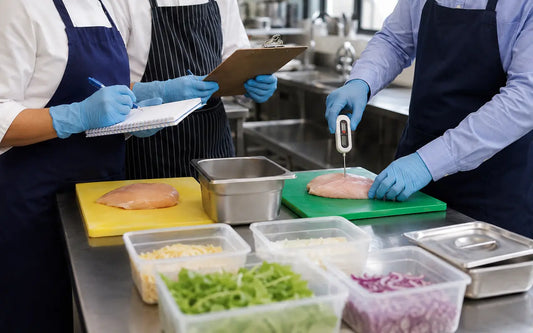
A suitable process may use a specified core temperature or an equivalent time-and-temperature combination. Thermometers should be appropriate for the task, checked for accuracy and cleaned between uses.
Chilling slows the growth of many harmful microorganisms but does not sterilise food. Businesses must protect the cold chain from delivery through storage, preparation, display and transport.
Hot food intended for later service should move through growth-supporting temperatures promptly. Large containers, deep trays and overfilled refrigerators can delay cooling even when the air temperature appears acceptable.
Cross-contamination occurs when microorganisms or other hazards move from one food, surface, person or item of equipment to another. It may occur through direct contact, hands, cloths, utensils, cutting boards, splashes, drips or poor storage order.
Raw food should be separated from ready-to-eat food through workflow, scheduling, physical space, equipment allocation and controlled storage. Colour coding can help, but only when staff understand the system and items are cleaned correctly.
Explore The 4 C’s of Food Safety Explained and the detailed guide to cross-contamination in food premises.

Key takeaway: Food businesses must control biological, chemical, physical and allergenic contamination rather than concentrating only on bacteria.
The four main contamination categories are biological, chemical, physical and allergenic. A complete hazard analysis considers all four because the source, consequence and control measures differ.
|
Contamination type |
Examples |
Common routes |
Principal controls |
|
Biological |
Bacteria, viruses, parasites, moulds and microbial toxins |
Raw ingredients, infected handlers, pests, water, equipment and inadequate temperatures |
Approved suppliers, hygiene, cooking, chilling, separation and cleaning |
|
Chemical |
Cleaning chemicals, pesticides, lubricants, excessive additives and natural toxins |
Incorrect storage, misidentification, poor rinsing, damaged equipment or unsuitable containers |
Approved products, secure storage, labelling, dosing, maintenance and staff instruction |
|
Physical |
Glass, metal, stones, plastic, wood, packaging fragments and personal items |
Damaged equipment, broken packaging, maintenance, raw materials or poor personal practices |
Inspection, maintenance, protective controls, supplier standards and incident procedures |
|
Allergenic |
Unintended presence of substances causing allergies or intolerances |
Shared equipment, utensils, storage, rework, incorrect labels or recipe changes |
Allergen mapping, separation, validated cleaning, recipe control, label checks and communication |
Biological hazards frequently receive the most attention because they include pathogens such as Salmonella, Campylobacter, Listeria monocytogenes, Shiga toxin-producing Escherichia coli and norovirus.
Controls may be preventive, such as avoiding contamination, or lethal, such as a validated cooking process. Businesses must also consider survival and growth after cooking, particularly where food is cooled, sliced, handled or stored before service.
Chemical hazards can enter food through incorrect chemical use, unsuitable equipment, contaminated ingredients or uncontrolled maintenance. Physical hazards often result from equipment damage, packaging, raw materials or poor premises control.
A strong system includes preventive maintenance, glass and brittle-material procedures, chemical inventories, approved purchasing and a defined response when contamination is suspected.
Allergenic cross-contact is not the same as microbial cross-contamination. It concerns the unintended presence of an allergen in food that should not contain it. Commission Regulation (EU) 2021/382 added specific allergen-management requirements to the hygiene framework, including controls relating to equipment, containers and transport used for substances causing allergies or intolerances.
Read The Four Types of Food Contamination for a deeper comparison. Detailed allergen obligations belong in Food Allergen Awareness: The Complete Guide for Food Businesses.
Key takeaway: Food should spend as little time as practicable at temperatures that support rapid microbial growth, using limits based on applicable law and the business’s validated procedures.
The term temperature danger zone describes the range in which many foodborne bacteria can multiply comparatively quickly. A range of approximately 5°C to 63°C is commonly used in some European guidance, including Ireland. However, it is not a universal statutory band applied identically throughout the EU.
Regulation 852/2004 requires food businesses to maintain the cold chain and avoid temperatures that could create a health risk, but national legislation and official guidance often provide more detailed limits for particular foods and activities. For example, Spain’s Royal Decree 1021/2022 requires prepared food kept hot in covered retail activities to be maintained at 63°C or above, while allowing evidence-based alternatives in defined circumstances.
|
Stage |
Control objective |
Management action |
|
Delivery |
Accept food only within specified limits and in sound condition |
Check representative products, packaging and vehicle conditions |
|
Refrigerated storage |
Keep food within the legal or validated chilled range |
Monitor equipment, avoid overloading and respond to deviations |
|
Preparation |
Limit cumulative time outside temperature control |
Prepare in manageable batches and return ingredients promptly |
|
Cooking |
Achieve a validated pathogen-reduction treatment |
Check the thickest or slowest-heating part of the product |
|
Hot holding |
Maintain food above the applicable minimum |
Preheat equipment and verify product temperature |
|
Cooling |
Move food through growth-supporting temperatures promptly |
Use shallow portions, blast chilling or other validated methods |
|
Reheating |
Heat rapidly and thoroughly under the approved procedure |
Avoid repeated reheating and verify the process |
|
Transport and display |
Preserve the hot or cold chain |
Use suitable equipment and define action for delays |
Staff should understand what to do when a limit is missed. Corrective action may involve continued cooking, rapid chilling, shortened shelf life, isolation, disposal, equipment repair or management review. The appropriate action depends on the food, time, temperature and validated safety basis.
For detailed reference values and probe procedures, see The Temperature Danger Zone and Safe Food Temperatures. The food storage rules guide explains fridge order, stock rotation, date control and frozen storage.
Key takeaway: EU food businesses must operate hygienically, use HACCP-based procedures where applicable, register or obtain approval as required, maintain traceability and cooperate with official controls.
The central EU hygiene measure is Regulation (EC) No 852/2004 on the hygiene of foodstuffs. It applies general hygiene requirements across the food chain and makes food business operators primarily responsible for food safety. Regulation 853/2004 adds specific rules for many foods of animal origin. The European Commission describes these measures as key parts of the EU hygiene legislation that became applicable in 2006.
Depending on the business and activity, the regulation requires operators to:
The regulation allows flexibility in applying HACCP-based procedures, particularly where the nature and size of a business justify a proportionate approach. Flexibility does not remove the responsibility to understand hazards and control them effectively. Commission guidance explains how Good Hygiene Practices, prerequisite programmes and HACCP-based controls can be adapted without abandoning food safety outcomes.
Regulation (EC) No 178/2002, often called the General Food Law, establishes overarching principles including the responsibility not to place unsafe food on the market. Article 18 requires traceability through production, processing and distribution, while Article 19 addresses withdrawal, notification and recall responsibilities where food may not comply with safety requirements.
In practical terms, a food business should be able to identify:
See Food Traceability and Recalls for record requirements and the distinction between withdrawal and recall.
Commission Regulation (EU) 2021/382 amended Regulation 852/2004 in relation to food allergen management, food redistribution and food safety culture. Food business operators must establish, maintain and provide evidence of an appropriate food safety culture, taking account of the nature and size of the business.
Regulation (EU) 2017/625 provides the framework for official controls used to verify compliance with food and feed law. Competent authorities apply this framework through inspections, audits, sampling, documentary checks and other controls according to risk and national arrangements.
The specialist guide to food hygiene inspections and rating systems explains what inspectors assess and why public rating schemes differ between countries.
Key takeaway: Food handlers must protect food through effective hand hygiene, clean clothing, controlled behaviour and prompt reporting of conditions that may create a contamination risk.
Regulation 852/2004 requires people working in food-handling areas to maintain a high degree of personal cleanliness and wear suitable, clean and, where necessary, protective clothing. A person suffering from or carrying a disease likely to be transmitted through food must not handle food where contamination could occur and must report relevant illness or symptoms to the food business operator.
A business-wide personal-hygiene programme normally covers:
Handwashing facilities must be accessible, appropriately equipped and used at the correct moments. Gloves do not replace handwashing and can spread contamination when staff touch multiple surfaces without changing them.
This pillar article covers the system-level requirements only. Use Personal Hygiene for Food Handlers: The Essentials and Food Hygiene for Food Handlers: Practical Rules and Best Practice for person-level procedures.
Key takeaway: Effective hygiene normally requires cleaning before disinfection, using the correct product, concentration, contact time, method and verification.
Cleaning and disinfection perform different functions:
A typical structured process includes:
The exact sequence depends on the product instructions, surface, equipment and contamination risk. Mixing chemicals, using unlabelled containers or estimating dilution by eye can create both food-safety and occupational-safety hazards.
A useful cleaning schedule identifies:
Food-contact surfaces require particular control, but less visible areas also matter. Drains, seals, refrigeration components, cleaning tools, high-level surfaces and damaged joints can become persistent contamination sources.
Pest control should form part of the premises programme. Proofing, waste control, cleaning, stock inspection and monitoring are preferable to waiting for visible infestation. See Pest Control in Food Businesses for the signs and preventive controls.
Key takeaway: Food safety culture is the pattern of leadership, communication, competence and behaviour that determines whether procedures are followed in everyday work.
Food safety culture means the shared values, beliefs and behaviours affecting food safety. It is visible in decisions made under pressure: whether a damaged delivery is rejected, whether a missed temperature is reported and whether managers correct unsafe behaviour during busy service.
Commission Regulation 2021/382 requires food business operators to establish, maintain and provide evidence of an appropriate food safety culture. The regulation refers to management and employee commitment, leadership, awareness of hazards, open communication and sufficient resources.
A credible culture normally includes:
A signed policy alone is not evidence of a mature culture. More persuasive evidence includes completed actions, staff interviews, consistent records, realistic workloads, management meeting minutes and timely responses to incidents.
Read What a Food Safety Culture Is and How to Build One for implementation and measurement guidance.
Key takeaway: Training must be appropriate to each person’s work, with additional competence for supervisors and those responsible for HACCP-based procedures.
Regulation 852/2004 does not create one universal EU certificate or fixed course level for every role. It requires food handlers to be supervised and instructed or trained in food hygiene matters appropriate to their work. People responsible for developing and maintaining HACCP-based procedures must receive adequate training in applying the HACCP principles.
A role-based training model may include:
|
Role |
Typical competence needed |
|
Occasional or limited food handler |
Basic hazards, hand hygiene, contamination prevention and task-specific controls |
|
Regular food handler |
Practical hygiene, temperature control, cleaning, allergens, storage and reporting |
|
Team leader or supervisor |
Monitoring, coaching, corrective action, records and shift-level verification |
|
Manager or food safety lead |
Food safety management, legal responsibilities, HACCP oversight, validation and review |
|
Specialist role |
Additional competence for allergens, high-risk production, transport, maintenance, cleaning chemicals or laboratory controls |
Training should not be judged only by attendance. Businesses should check whether staff can perform the task correctly, explain important limits and respond appropriately when something goes wrong.
Refresher training may be necessary after:
The dedicated food hygiene training requirements guide compares handler, supervisor and management needs.
Prepare your team to meet Spain and EU food hygiene requirements, maintain APPCC records, and improve inspection readiness.
Key takeaway: Implementation should follow the actual food flow, assign clear responsibilities and produce evidence that significant controls are working.
A practical implementation sequence is:
List products, processes, consumers, service methods and operating locations. Include outsourced preparation, transport, temporary operations, online sales and food redistribution where relevant.
Document how food moves through:
Set controls for premises, water, equipment, maintenance, cleaning, personal hygiene, waste, pests, suppliers, storage, allergens and staff competence.
Consider biological, chemical, physical and allergenic hazards at each stage. Assess their significance according to likelihood and severity.
Determine where Good Hygiene Practices are sufficient and where specific critical controls are needed. Define limits, monitoring, corrective action, verification and records.
State who performs each check, who reviews it and who has authority to stop production, isolate food or arrange disposal.
Provide instruction in a language and format workers understand. Observe performance rather than relying only on a quiz or certificate.
Use record review, observation, internal audits, calibration, microbiological testing where appropriate, complaints and trend analysis.
Review the system when ingredients, suppliers, recipes, equipment, packaging, shelf life, staffing or legal requirements change.
Test whether affected stock can be identified and withdrawn quickly. Record lessons from exercises, complaints and real incidents.

A manager should be able to answer “yes” to the following:
Practical problems often arise where a procedure is technically correct but difficult to perform during normal service. Verification should therefore examine workload, layout, equipment and behaviour—not only whether a document exists.
Key takeaway: EU regulations create the common framework, but Member States add detailed requirements for temperatures, registration, training evidence, inspections and particular retail activities.
Regulations 178/2002, 852/2004 and 853/2004 apply across the EU, but national authorities administer registration, approval, official controls and enforcement. Member States may also adopt national measures where EU law permits flexibility or requires local detail.
Country-level differences may concern:
Spain, for example, supplements EU hygiene law through national measures including Royal Decree 1021/2022 for specified retail food activities. Other Member States use their own implementing legislation and official guidance. Businesses operating in several countries should avoid assuming that a process accepted in one jurisdiction automatically satisfies every local detail elsewhere.
A public food hygiene score is also not harmonised across the EU. Some countries or local authorities publish ratings; others use different disclosure systems or no comparable consumer-facing scale.

Key takeaway: Training is most effective when it supports the business’s procedures, risks and staff responsibilities.
Spanish Compliance Institute’s food hygiene and safety training helps employees understand the controls behind safe food handling, including contamination prevention, cleaning, temperature management and everyday hygiene responsibilities.
Businesses can also use the free 4Cs kitchen poster as a visual reminder of Cleaning, Cooking, Chilling and Cross-contamination controls. Training and posters should support—not replace—the organisation’s own HACCP-based procedures, supervision and verification.
Strengthen your food safety knowledge through practical online training designed for food handlers, supervisors, and hospitality businesses.
Key takeaway: This guide is based on current primary legislation, official EU guidance, recognised international principles and the latest available EU zoonoses evidence.
The article was developed using:
Principal sources consulted: