Featured Course
Food Hygiene and Safety
Develop practical knowledge of safe food handling, allergen management, contamination control, and EU hygiene responsibilities.

Cross-contamination is the unintended transfer of harmful microorganisms or allergens from food, hands, equipment or surfaces to another food. The main routes are direct contact, indirect transfer and drips. EU food businesses should prevent it through separation, hygienic storage, dedicated equipment, effective cleaning and trained staff.
Cross-contamination can turn safe, ready-to-eat food into a source of foodborne illness without changing its appearance, smell or taste. A knife used for raw poultry, a wiping cloth moved between workstations or liquid leaking from raw food can transfer microorganisms to food that will receive no further cooking.
Preventing that transfer is one of the central principles covered by the 4 C’s of food safety and the wider food hygiene and safety system. The controls must be built into the layout, storage arrangements, procedures, equipment and everyday behaviour of the food business—not left to individual judgement during a busy service.
Key takeaway: Cross-contamination occurs when harmful material is transferred from a contaminated source to food, equipment or another surface.
The European Food Safety Authority defines cross-contamination as the unintended transfer of microbes from one substance or object to another with a harmful effect. In a food business, the source may be raw meat, poultry, seafood, unwashed produce, hands, cloths, packaging, utensils, equipment or a contaminated food-contact surface.
The receiving food presents the greatest risk when it is ready to eat. A cooked meal, prepared salad, sandwich filling or dessert may not undergo another control step capable of reducing harmful microorganisms before it reaches the customer.
Cross-contamination may involve:
This article focuses primarily on microbial cross-contamination. The broader categories of biological, chemical, physical and allergenic hazards are covered separately in the four types of food contamination.
Regulation (EC) No 852/2004 on the hygiene of foodstuffs requires food businesses to protect food from contamination at all relevant stages and to store raw materials and ingredients under conditions that prevent harmful deterioration and contamination. The regulation establishes the legal outcome; each business must translate that outcome into controls appropriate to its products, processes and risks.
Separation, dedicated equipment, storage order, cleaning and staff supervision are therefore not isolated tips. They are practical ways of meeting the wider duty to control contamination through good hygiene practices and HACCP-based procedures.

Key takeaway: The three practical routes are direct contact, indirect transfer and drip contamination.
Direct, indirect and drip contamination are useful training categories rather than separate statutory definitions in EU legislation. They help staff recognise how microorganisms move through a real kitchen.
Direct cross-contamination occurs when a contaminated food touches another food.
Examples include:
The transfer may happen during delivery, storage, preparation, display or service. Physical separation is the most reliable control.
Indirect cross-contamination occurs when microorganisms are carried through an intermediate object or person.
Common transfer vehicles include:
A surface does not need to look dirty to transfer microorganisms. This is why cleaning must remove food residue and soiling before an appropriate disinfection step is applied. The business should also follow the correct product dilution, contact time and rinsing instructions. See the full guide to cleaning and disinfection in food premises.
Drip contamination happens when liquid from raw or contaminated food falls onto another product, container or food-contact surface.
Examples include:
Drip contamination is especially dangerous in refrigerators because the source may remain unnoticed for hours. Raw food should therefore be covered, placed in sound leakproof containers and stored below ready-to-eat products.
Develop practical knowledge of safe food handling, allergen management, contamination control, and EU hygiene responsibilities.
Key takeaway: Microorganisms may sometimes be reduced through cooking, but allergenic proteins are not made reliably safe by ordinary cooking.
Microbial cross-contamination and allergen cross-contact can follow the same routes, but the hazards and required controls are not identical.
|
Issue |
Microbial cross-contamination |
Allergen cross-contact |
|
Hazard transferred |
Harmful bacteria, viruses or other microorganisms |
An allergenic ingredient or allergenic protein |
|
Common sources |
Raw meat, poultry, seafood, hands, cloths and dirty equipment |
Shared utensils, fryers, mixers, production lines, storage containers or airborne powders |
|
Main concern |
Foodborne illness |
An allergic reaction in a sensitive consumer |
|
Can normal cooking solve it? |
Adequate cooking may reduce many microorganisms in the food being cooked |
Cooking does not reliably remove the allergen risk |
|
Core controls |
Separation, cleaning and disinfection, temperature control and hygienic handling |
Allergen segregation, validated cleaning, recipe control, accurate information and managed production scheduling |
Commission Regulation (EU) 2021/382 amended the hygiene requirements to address food allergen management, food redistribution and food safety culture. It introduced explicit hygiene provisions intended to prevent or limit the unintended presence of substances that cause allergies or intolerances.
For clarity, many food-safety professionals use allergen cross-contact for unintended allergen transfer and reserve cross-contamination mainly for microorganisms. Businesses need a dedicated allergen-management system rather than assuming that ordinary microbial cleaning controls are automatically sufficient.
Key takeaway: Cross-contamination usually occurs during routine transitions between tasks rather than through one dramatic failure.
The following scenarios show how apparently small decisions can bypass the food-safety system.
A worker prepares raw chicken, gives the board a quick wipe and then uses it for salad vegetables. The board may still hold contaminated food residue, particularly around knife marks.
Control: Use clearly identified equipment for raw and ready-to-eat tasks, followed by a complete cleaning and disinfection procedure.
A food handler checks a phone, adjusts a screen or touches a payment device and then resumes assembling sandwiches without washing their hands.
Control: Keep personal devices outside food-preparation areas or introduce a defined handwashing step after contact.
A worker believes gloves replace handwashing and wears the same pair while handling raw food, opening a refrigerator and touching prepared food.
Control: Treat gloves as task-specific equipment. Change them between incompatible tasks and wash hands at the required points.
A damp cloth is used on a raw-meat workstation and then moved to a preparation counter. The cloth spreads contamination over a larger area.
Control: Use a controlled cloth system, separate cloths by task or area, and replace or disinfect them at defined intervals.
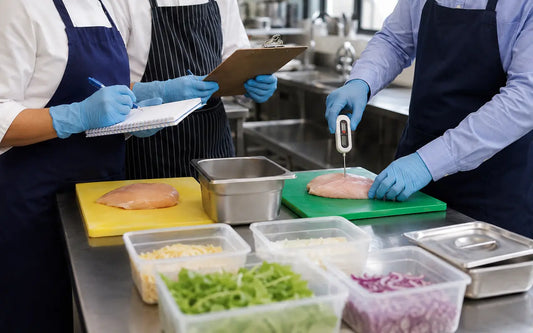
A thermometer checks raw poultry and is immediately inserted into cooked food.
Control: Clean and disinfect the probe before and after each use, following the manufacturer’s instructions.
A raw product leaks onto prepared food below. The contamination may remain hidden until service.
Control: Store raw food below ready-to-eat food in covered, leakproof containers.
EFSA’s practical food-handling guidance similarly recommends keeping raw meat, poultry and seafood separate, using different utensils and boards for raw food and storing raw and cooked food separately in the refrigerator.
Key takeaway: Effective prevention combines separation, controlled workflow, hygienic storage, dedicated tools, cleaning and staff competence.
No single control is sufficient in every kitchen. The business should use several mutually supporting measures.
Where possible, create separate work areas for:
Physical separation is preferable. Where space is limited, separate tasks by time and complete a documented cleaning and disinfection procedure between them.
Food, staff, utensils and waste should move in a way that reduces contact between dirty and clean activities.
A practical flow is:
Avoid carrying dirty trays, outer packaging or waste through clean preparation zones.
Provide enough equipment for staff to maintain separation during busy periods. This may include separate:
Colour-coding can make the system easier to follow, but there is no single EU-wide statutory colour sequence for every food business. The colours used should be documented, consistently applied and understood by staff.
Staff should wash their hands at operationally relevant points, including:
Handwashing facilities must be accessible, adequately supplied and supported by supervision.
Cleaning removes food residue, grease and dirt. Disinfection reduces microorganisms on an already clean surface.
A suitable procedure should define:
Use sound, covered containers and keep food away from floors, dirty packaging, chemicals, pests and splash risks. Refrigerators should not be overloaded to the point that safe separation becomes impossible.
Training should explain not only what the rules are but how cross-contamination occurs in the employee’s own tasks.
Supervisors should observe whether staff:

Key takeaway: Ready-to-eat food should be protected above, while raw food belongs below in covered, leakproof containers.
A safe refrigerator layout prioritises separation and containment:
|
Refrigerator area |
Suitable contents |
Main control |
|
Upper shelves |
Cooked food, ready-to-eat food, prepared desserts and protected garnishes |
Keep covered and isolated from raw products |
|
Middle shelves |
Prepared ingredients and washed produce in closed containers |
Label clearly and protect from handling contamination |
|
Lower shelves |
Raw meat, poultry, seafood and other raw animal products |
Use separate, leakproof containers below ready-to-eat food |
|
Lowest protected area |
High-drip-risk raw products where the refrigerator design permits |
Use sound trays or containers that contain leakage |
|
Separate compartment, where available |
Unwashed produce, allergens or specialist products requiring segregation |
Follow the documented site-specific storage plan |
The exact shelf arrangement depends on the refrigerator design and the foods handled. The non-negotiable principle is that raw products must not leak, drip or make contact with ready-to-eat food.
For stock rotation, date control, dry storage and frozen-food arrangements, see the detailed food storage rules guide.
Country variations: Regulation (EC) No 852/2004 provides EU-wide hygiene requirements, but Member States and sector authorities may publish more detailed good-practice guides. Requirements or recommendations relating to premises, equipment, training evidence and local inspection practice may therefore vary. Businesses should consult the competent national or regional authority and their applicable sector guide.

Key takeaway: Managers should verify the control system rather than relying only on written procedures.
Use this checklist during opening checks, routine supervision and internal reviews:
Key takeaway: Training is most effective when staff can apply the controls to their own workstations and responsibilities.
The Spanish Compliance Institute Food Hygiene and Safety course helps food handlers and managers understand how contamination occurs and how cleaning, separation, storage, temperature control and safe working practices fit together.
Training supports the food-safety system, but it does not replace premises-specific procedures, supervision, monitoring or corrective action. Businesses should adapt the principles to their activities, products, customers and national requirements.
Learn how to maintain hygiene controls, accurate APPCC records, safe temperatures, and consistent standards across food operations.
Key takeaway: This article is based on binding EU legislation, official EU guidance and recognised professional food-hygiene practices.
The article was prepared using the target search intent and content brief, then checked against current authoritative sources. Legal requirements have been distinguished from practical training models and voluntary good practice.
Principal sources consulted:
This content provides general educational guidance and is not legal advice. National legislation, sector rules, official guidance and the requirements of the competent authority may add more specific controls.