

Allergen mistakes can be serious.
For some customers, a small amount of the wrong food can cause a dangerous reaction. This can happen in a restaurant, café, bakery, hotel buffet, catering business, food truck, supermarket food counter, school canteen, care home kitchen, or market stall.
That is why allergen awareness training matters for food handlers in Spain.
Many food workers think allergens are only a manager’s job. That is not true. Any person who prepares, serves, stores, labels, packs, delivers, or explains food can affect allergen safety.
A waiter who guesses an answer can create risk. A cook who uses the same spoon for two sauces can create risk. A bakery worker who places nut products beside plain pastries can create risk. A food truck worker who uses shared toppings without checking ingredients can create risk.
Allergen safety is not only about knowing a list of allergens. It is about safe habits. It is about checking before answering. It is about preventing cross-contact. It is about clear communication between the kitchen, service team, manager, and customer.
This guide explains what allergen awareness training should teach food handlers in Spain, why it matters, what common mistakes happen, and how workers can handle allergen questions more safely.
What Is Allergen Awareness Training?
Allergen awareness training teaches food workers how to understand and manage allergen risks.
It helps workers know what allergens are, where allergen information can be found, how cross-contact can happen, and what to do when a customer asks about ingredients.
This training is important because allergens are not always visible. A food may look safe but still contain milk, egg, nuts, gluten, sesame, soy, or another allergen. A sauce may contain an allergen. A topping may contain an allergen. A fryer, tray, knife, board, or glove may also spread allergen traces from one food to another.
Allergen awareness is not only about memorising a list. Food handlers need to know how to behave.
A trained worker should know when to check. They should know when to ask a supervisor. They should know not to answer from memory if they are unsure. They should know that cross-contact can happen even when ingredients are correct.
Allergen awareness should be part of wider food handler training. For a full overview of food handler training in Spain, read Food Handler Training in Spain: Online Course, Certificate and 2026 Rules.
Why Food Handlers in Spain Need Allergen Awareness
Food businesses in Spain need to take allergen information seriously.
Customers may ask what is in a dish. They may ask if a product contains nuts, milk, gluten, egg, fish, sesame, soy, or another allergen. They may also ask if food has been prepared near another food.
A careless answer can harm the customer.
This is why food handlers need training. The safest food business is not the one where staff “think they know.” It is the one where staff know how to check.
Allergen mistakes often happen during busy service. Someone is rushing. A customer asks a question. The worker wants to be helpful. Instead of checking, they guess.
That guess can be dangerous.
A better response is simple:
“I will check the allergen information for you.”
This protects the customer. It also protects the worker and the business.
Allergen awareness is also important because modern food hygiene is broader than handwashing. Food handlers need to understand hygiene, contamination, allergens, cleaning, temperature control, and safe communication. For a wider guide to the certificate side of food safety training, read Food Hygiene Certificate Spain: What You Need to Know.
Who Needs Allergen Training?
Allergen training is useful for anyone whose work can affect food information or food safety.
This can include kitchen staff, chefs, cooks, waiters, bar workers, café staff, bakery workers, catering teams, food truck workers, market food vendors, hotel buffet staff, supermarket deli workers, care home kitchen workers, school canteen staff, and food production workers.
The need is not based only on job title.
A person who cooks food clearly needs allergen awareness. But a person who serves food also needs it, because they may speak directly with the customer. A person who stores ingredients needs it, because allergens can be mixed or badly labelled. A person who cleans equipment needs it, because shared tools can spread allergen traces.
Even a new worker should understand the basic rule: never guess allergen information.
The depth of training should match the role.
A front-of-house worker may need strong training on customer questions, communication, and where to check information. A kitchen worker needs to understand ingredients, recipes, storage, cleaning, and cross-contact. A supervisor needs to know how allergen information is controlled, updated, and shared with staff.
Allergen safety works best when the whole team understands their part.
What Are Food Allergens?
A food allergen is a substance in food that can cause an allergic reaction in some people.
Common allergen risks include cereals containing gluten, milk, eggs, fish, peanuts, soy, nuts, celery, mustard, sesame, sulphites, lupin, crustaceans, and molluscs.
These allergens can appear in obvious foods. Milk may be in cheese. Egg may be in mayonnaise. Nuts may be in a cake. Fish may be in a fish dish.
But allergens can also appear in less obvious places.
Milk may be in a sauce. Gluten may be in a thickener. Sesame may be in bread. Soy may be in a dressing. Mustard may be in a marinade. Sulphites may be in some dried fruits or drinks.
This is why guessing is unsafe.
A food handler should not rely only on how food looks. They should not assume a product is safe because the allergen is not visible. They should not answer based only on memory.
Recipes can change. Suppliers can change. Ingredients can change. Labels can change. Staff can make mistakes.
The right habit is to check reliable information.
Why “Do Not Guess” Is the Most Important Rule
The most important allergen rule for food handlers is simple:
Do not guess.
If a customer asks about an allergen, the answer should come from reliable information. It should not come from memory, confidence, habit, or appearance.
A worker may want to be helpful. They may feel pressure during busy service. They may think they know the answer. But if they are not sure, they should not answer as if they are sure.
The safer answer is:
“I need to check that for you.”

This is not weak service. It is good service.
Customers with allergies often need clear and careful answers. They are not asking to make life difficult. They are asking because the answer may affect their health.
A food business should make it easy for staff to check. Allergen information should be available, clear, and updated. Staff should know where it is kept and who to ask if something is unclear.
Good allergen training gives workers confidence to pause and check.
That pause can prevent a serious mistake.
Allergen Cross-Contact Explained Simply
Allergen cross-contact happens when an allergen moves into a food where it should not be.

This can happen even if the recipe itself does not include the allergen.
For example, a plain pastry may not contain nuts in the recipe. But if it is handled with the same tongs used for nut pastries, there may be a risk. Chips may not contain fish, but if they are fried in oil used for fish, there may be a risk. A salad may not contain milk, but if cheese is handled nearby with shared gloves or tools, there may be a risk.
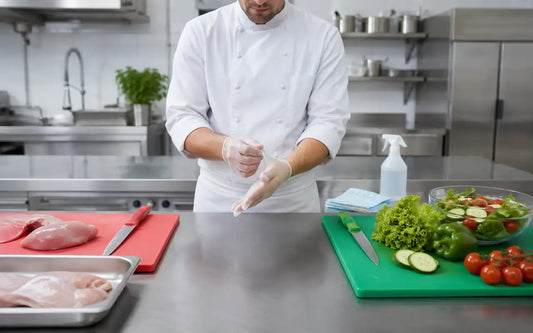
Cross-contact can happen through hands, gloves, boards, knives, trays, fryers, grills, storage boxes, toppings, sauces, cloths, counters, and display areas.
This is why allergen control is practical. It is not only about paperwork.
Workers need to think about movement.
Where did this tool go before? What food touched this surface? Did I change gloves? Was the tray cleaned? Is the topping spoon shared? Are the products stored together? Did the recipe change?
Good training helps workers see these risks during real work.
Allergen Risks in Restaurants, Cafés, Bakeries, and Food Trucks
Different food businesses have different allergen risks.
In restaurants, risk can come from sauces, marinades, shared utensils, shared fryers, unclear recipes, and rushed communication between kitchen and front-of-house staff.
In cafés, risk can come from milk, plant-based drinks, pastries, cakes, sandwiches, toppings, syrups, and shared preparation areas.
In bakeries, allergens are often a major issue. Gluten, milk, eggs, nuts, sesame, soy, and other ingredients may be used in the same space. Flour dust, trays, display areas, and shared tools can create cross-contact risks.
In food trucks and street food stalls, space is often limited. Workers may prepare, cook, serve, store, and take orders in a small area. This can make allergen control harder. Clear storage, clean tools, and careful communication are very important.
In hotels and buffets, risk can come from shared serving spoons, unclear labels, customer self-service, mixed trays, and food being moved between areas.
In supermarkets and deli counters, risk can come from slicers, display cases, shared gloves, tongs, labels, and packaging.
Each setting is different, but the same rule applies: allergen information must be checked, and cross-contact must be controlled.
If you work with mobile food, stalls, or event food, read Street Food in Spain: Food Handling Rules Vendors Must Know in 2026.
What Food Handlers Should Do When Customers Ask
When a customer asks about an allergen, the food handler should stay calm and careful.
The worker should listen to the question. They should not rush the answer. They should check the correct allergen information. If they are unsure, they should ask the person responsible.
The worker should not say “it should be fine.” They should not say “I think so.” They should not answer based on how the food looks.
A better answer is clear and honest.
If the information confirms the allergen is present, say so. If the information confirms it is not present, explain based on the available information. If there is a risk of cross-contact, that should also be communicated when relevant.
The worker should also know when they cannot safely answer.
For example, if a recipe has changed and the allergen information has not been updated, the safest response is to check with the responsible person before serving.
Good allergen communication should be simple, honest, and careful.
Allergen Information and Food Labels
Food handlers should understand where allergen information comes from.
It may come from ingredient labels, supplier documents, recipe sheets, menu information, allergen charts, product specifications, or internal records.
For packaged food, labels can give important allergen information.
For food prepared and served in a restaurant, café, bakery, or catering business, the business still needs a way to provide accurate allergen information. Staff should know where to find it.
This matters because recipes and suppliers can change.
A sauce may change supplier. A bread may now contain sesame. A dessert may start using nut decoration. A plant-based product may contain soy. A ready-made ingredient may change its label.
If the allergen information is not updated, staff may give wrong answers.
That is why allergen control is not only a worker issue. It is a business system issue.
The business should keep allergen information clear, current, and easy for staff to use.
Cleaning, Storage, and Shared Equipment
Cleaning is important for allergen control, but cleaning must be done properly.
If a surface, tray, board, knife, or tool has touched an allergen, it may need cleaning before it is used for another food. A quick wipe may not be enough.
Storage also matters.
Allergenic ingredients should be stored in a way that avoids spills, mixing, and confusion. Labels should be clear. Containers should not be reused in a way that creates risk. Toppings, powders, sauces, and open ingredients should be controlled carefully.
Shared equipment can be a common problem.
A shared fryer, grill, slicer, blender, mixer, tray, spoon, or tong can move allergens from one food to another. Workers should understand when shared equipment creates risk and what the business procedure says.
This is especially important in small kitchens and food trucks, where space is limited.
Good allergen awareness means thinking before using a tool, not after the food is already served.
Allergen Awareness and Food Safety Culture
Allergen safety depends on culture.
A strong food safety culture means staff take allergen questions seriously. They check before answering. They report unclear information. They do not hide mistakes. They do not guess during busy service.
A weak culture sounds different.
“It is probably fine.”
“We always make it that way.”
“The customer will know.”
“We are too busy to check.”
“Just say no.”
These are dangerous habits.
Food safety culture means safe behaviour is normal, even when the workplace is busy. It means workers feel allowed to stop and check. It means managers support careful answers. It means allergen information is easy to find.
A certificate is useful, but the daily habit matters more.
Allergen awareness training helps build that habit.
Need food handler training that includes allergen awareness, hygiene, and safe food handling basics? Complete online training and keep your certificate ready as evidence.
Enrol Now and Get Certified →
Online Allergen Awareness Training
Online training can be a useful way to learn allergen awareness.
It allows learners to study at their own pace and review key ideas before taking an assessment. It can also help employers train staff in a consistent way.
Online training works best when it uses clear language and real examples.
A good allergen section should not only list allergens. It should explain how allergen mistakes happen in real work. It should cover customer questions, cross-contact, labels, storage, shared tools, cleaning, and communication.
The course should also connect allergen awareness to wider food handler duties.
Allergens are not separate from hygiene. They are part of food safety.
For more on online food hygiene training, read Online Food Hygiene Course in Spain.
Common Allergen Mistakes to Avoid
One common mistake is guessing.
This is the biggest mistake. If a worker is unsure, they should check.
Another mistake is thinking allergens are only a kitchen issue. Front-of-house staff also need awareness because they speak to customers.
Another mistake is relying only on memory. Recipes and suppliers can change.
Another mistake is ignoring cross-contact. A food can be unsafe for an allergic customer even when the allergen is not part of the recipe.
Another mistake is using shared utensils without thinking. Tongs, spoons, knives, trays, boards, and fryers can all move allergen traces.
Another mistake is not updating allergen information when the menu changes.
Another mistake is treating allergen training as a one-time task. Refresher training may be needed when recipes, suppliers, equipment, menus, or staff change.
Allergen safety is not about fear. It is about careful habits.
Allergen Awareness Checklist for Food Handlers

Before handling or explaining food, food handlers should be able to answer these questions.
Do I know where allergen information is kept?
Do I know who to ask if I am unsure?
Do I understand why guessing is unsafe?
Do I know how cross-contact can happen?
Do I know which tools or equipment may be shared?
Do I know how ingredients are labelled and stored?
Do I know what to do if a customer asks about an allergen?
Do I know when to stop and check before serving?
Do I understand my role in protecting the customer?
This checklist is simple, but it can prevent serious mistakes.
Continue Reading
Food Handler Training in Spain: Online Course, Certificate and 2026 Rules
Food Hygiene Certificate Spain: What You Need to Know
Online Food Hygiene Course in Spain
Spain Food Handler Test: Questions, Quiz and What to Expect
Food Handlers Manual PDF Spain
Written by Marcus Delfield for the Spanish Compliance Institute — professional certification in compliance, regulation, and ethics for professionals working in Spain and across the EU.