If you want to work with food in Spain, you may hear many names for the same thing.
Some people call it food handler training. Some call it a food handler certificate. Some call it a food hygiene certificate. In Spanish, you may see manipulador de alimentos, certificado de manipulador de alimentos, curso de manipulador de alimentos, or carnet de manipulador de alimentos.
This can feel confusing at first.
You may be starting a job in a restaurant, café, bar, bakery, hotel, supermarket, food truck, catering company, market stall, school canteen, or food production site. You may be an employer trying to train staff. You may be an international worker who wants to know if training in English is accepted. Or you may simply want to know whether the old food handler card is still needed in Spain.
The simple answer is this:
Food handlers in Spain need suitable food hygiene training for the work they do. A certificate is the normal way to show that this training was completed.
But the certificate is not the whole story.
Good food handler training should help you work safely with food. It should help you understand clean hands, safe storage, allergens, cleaning, temperature control, cross-contamination, HACCP basics, and what to do when something goes wrong.
It should also help employers keep training evidence. This can matter during hiring, staff onboarding, audits, inspections, and daily food safety checks.
This guide explains food handler training in Spain in plain English. It covers online training, certificates, the old food handler card, food hygiene rules, the food handler test, free resources, English and Spanish training, and the key mistakes to avoid.
What Is Food Handler Training in Spain?
Food handler training teaches people how to handle food safely.
In Spain, this is often linked to the phrase manipulador de alimentos. That simply means food handler. A food handler is a person whose work can affect food safety.
This can include preparing food, cooking food, serving food, storing food, packing food, carrying food, selling food, cleaning food surfaces, or giving customers food information.
Food handler training is not only for chefs. It can also matter for waiters, bar staff, bakery workers, hotel breakfast staff, food truck workers, supermarket deli staff, catering teams, food production workers, and cleaners who clean food-contact surfaces.
The goal is simple. Food should stay safe from the moment it enters the business until the moment it reaches the customer.
A good course should help learners understand why food can become unsafe and how to stop that from happening. It should not only help someone pass a quiz. It should help them make safer choices at work.
This matters because food safety problems often start with small actions. A worker may forget to wash hands. Raw food may touch ready-to-eat food. A customer may ask about allergens, and staff may guess. A fridge may fail, and nobody reports it. A surface may look clean but still need disinfection.
Food handler training helps workers understand these risks before they become real problems.
If you want a wider guide to the whole topic of food handling, read Everything You Need to Know About Food Handling.
Who Needs Food Handler Training?
You may need food handler training if your work can affect food safety.
This does not only mean touching food with your hands. It can also mean touching tools, surfaces, packaging, storage areas, or food equipment. It can also mean answering customer questions about ingredients or allergens.
A kitchen assistant can affect food safety by washing vegetables, cleaning boards, or handling raw meat. A waiter can affect food safety by handling ready-to-eat food or answering allergen questions. A bakery worker can affect food safety through allergens, shared tools, and display hygiene. A food truck worker can affect food safety through storage, water, waste, cleaning, and temperature control.
The important question is not, “Is my job title food handler?”
The better question is, “Can my work affect whether food is safe to eat?”
If the answer is yes, you need suitable food hygiene training.
Training should also match the work. A worker who handles packaged snacks may need a basic level of training. A cook who handles raw chicken needs deeper knowledge of cross-contamination, cooking, cleaning, and storage. A supervisor may need stronger knowledge of HACCP, records, staff training, and corrective actions.
This is why one-size-fits-all thinking can be risky. Food handler training should fit the real job.
If you are trying to understand the step-by-step route to getting certified, read How to Get a Food Handler Certificate in Spain.
Is Food Handler Training Required in Spain?
Yes. Food handlers in Spain need suitable food hygiene training, instruction, or supervision for the work they do.
The rule is not only about having a paper certificate. The deeper point is that food businesses must make sure workers know how to handle food safely.
This idea comes from EU food hygiene rules. Food business operators must make sure food handlers are supervised, instructed, or trained in food hygiene matters in a way that fits their work.
In plain words, the business has to make sure staff know what they are doing.
This does not mean every worker needs the same level of training. A person serving packaged drinks may not need the same depth as a cook handling raw meat. A supervisor may need more detailed training than a new food counter worker.
But if the work can affect food safety, training is needed.
A certificate is the normal way to show that training was completed. Employers may keep it in staff records. Workers may use it when applying for food jobs. Self-employed food vendors may keep it with their food safety documents.
The certificate is useful. But the real goal is safe food handling.
Food Handler Certificate, Food Hygiene Certificate, or Manipulador de Alimentos?
Many people search for different names and wonder if they mean different things.
In everyday use, food handler certificate, food hygiene certificate, and food handling certificate often mean almost the same thing. They usually refer to proof that someone completed food hygiene training.
In Spanish, the common phrase is certificado de manipulador de alimentos.
You may also see phrases like manipulador de alimentos online, curso manipulador de alimentos, manipulador de alimentos certificado, or carnet manipulador de alimentos.
The names may change, but the need is usually the same. A worker needs training, and the employer may need proof.
A certificate may show the learner’s name, the course name, the training provider, the date of completion, and sometimes a certificate number or verification method. It may also mention the topics covered.
But the name on the certificate is not the most important thing.
The most important thing is whether the training is clear, useful, and suitable for the work.
A certificate should not be treated like a magic pass. It shows training was completed. It does not prove that the person will always handle food safely. The worker still needs to use the training every day.
For a deeper guide focused only on this document, read Food Hygiene Certificate Spain: What You Need to Know.
Do You Still Need a Food Handler Card in Spain?
This is one of the most common questions.
Many people still search for food handler card Spain or carnet de manipulador de alimentos. Some employers still say “card” because that old phrase is familiar. Some job adverts still use it. Many older websites also use it.
But Spain no longer works under the old government-issued food handler card model in the same way.
Today, the focus is on suitable training and proof that the training was completed. That proof is usually a certificate from a training provider.

So if someone asks, “Do I still need a food handler card in Spain?” the better answer is this:
You do not usually need an old-style government card. You need suitable food handler training and proof of completion.
This matters because advice from other countries can be confusing. In some places, a food handler card may be issued by a local health department. Spain’s current model is different. In Spain, the food business must make sure workers are trained for their role and must be able to show evidence when needed.
If you are still unsure about the card issue, read Do You Still Need a Food Handler Card in Spain?.
How Online Food Handler Training Works
Online food handler training is a simple way to complete food hygiene training without going to a classroom.
A learner studies the course online, reviews the key topics, takes a test or final assessment, and receives a certificate after passing.

This can be useful for job seekers who need training evidence before applying for food work. It can also help employers train staff in a clear and steady way. It can be helpful for international workers who want food handler training in English, Spanish, or both.
Online training can work well when the content is clear, current, and easy to understand.
But online training should not be treated as a shortcut around real learning.
A good online course should teach the food safety risks people face at work. It should explain real examples from kitchens, cafés, bakeries, food trucks, hotels, catering businesses, supermarkets, and food production sites.
It should help the learner answer real questions, such as:
What should I do after handling raw chicken?
Should I guess if a dessert contains nuts?
Can I use the same board for raw meat and salad?
What should I do if chilled food arrives warm?
Is wiping a surface the same as disinfecting it?
What should I report to my manager?
A course gives the foundation. But the employer still needs to explain the workplace rules. Each business has its own cleaning plan, storage system, allergen information, temperature records, reporting process, and equipment.
The strongest approach is usually online certificate training plus workplace instruction.
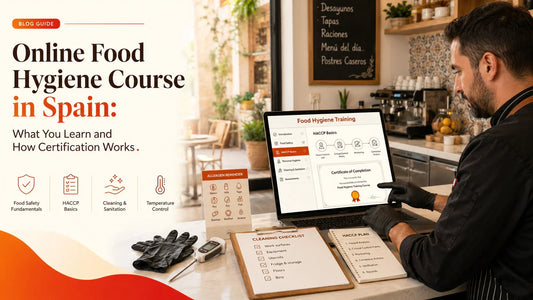
For more detail on how online training works, read Online Food Hygiene Course in Spain.
Need food handler training for work in Spain? Complete online Food Handler Training in English or Spanish, pass the final assessment, and keep your certificate ready as training evidence.
Enrol Now and Get Certified →
What a Good Food Handler Course Should Teach
A good food handler course should not feel like empty paperwork.
It should help the learner understand how food becomes unsafe and what they can do to prevent it.
The course should start with personal hygiene. This includes handwashing, clean clothing, illness reporting, safe glove use, hair control, wounds, and behaviour around food.
It should explain contamination. Food can become unsafe because of germs, chemicals, objects, or allergens. These risks are not always visible.
It should explain cross-contamination. This is when germs or allergens move from one food, surface, person, tool, or area to another.
It should teach temperature control. Some foods must be kept cold. Some must be kept hot. Some must be cooked fully. Some must be cooled safely before storage.
It should explain cleaning and disinfection in simple words. Cleaning removes dirt. Disinfection lowers germs. A surface can look clean and still be unsafe.
It should also cover safe storage, waste, pest awareness, allergens, HACCP basics, and food safety culture.
These topics are not just school-style lessons. They are daily work skills.

A food handler should know when to stop, when to check, when to clean, when to report, and when not to serve something.
That is what good training should do.
Personal Hygiene: The First Rule of Safe Food Work
Personal hygiene is one of the first things every food handler should learn.
Food handlers can carry germs on their hands, clothing, hair, skin, phones, jewellery, wounds, and personal items. If these germs reach food, surfaces, or tools, customers can be put at risk.
Handwashing is the most important habit.
Hands should be washed before handling food, after using the toilet, after touching raw food, after touching waste, after coughing or sneezing, after touching the face or hair, after cleaning, after breaks, and when changing tasks.
A quick rinse is not enough. Hands should be washed properly with clean water and soap. They should also be dried safely.
Gloves can help in some situations, but they do not replace handwashing. Dirty gloves can spread contamination just like dirty hands. If gloves are used, they should be changed when tasks change or when they become dirty.
Clean work clothing also matters. Hair should be controlled. Cuts and wounds should be covered. Jewellery and loose personal items should be controlled because they can carry germs or fall into food.
Illness reporting is also important. A worker with vomiting, diarrhoea, fever, infected wounds, or symptoms that may affect food safety should report the issue before handling food.
Personal hygiene is not about looking neat. It is about protecting food.
Contamination and Cross-Contamination
Contamination means something unsafe gets into food.
This may be germs, chemicals, objects, or allergens.
Biological contamination can come from bacteria, viruses, parasites, mould, raw food, dirty hands, pests, waste, water, or sick workers.
Chemical contamination can come from cleaning chemicals, pesticides, chemical residues, or unsafe containers.
Physical contamination can happen when glass, metal, plastic, hair, stones, packaging pieces, or jewellery get into food.
Allergenic contamination happens when an allergen enters food where it should not be, or when allergen information is wrong.
Cross-contamination means contamination moves from one place to another.
This can happen very easily.
Raw chicken can touch salad. A knife used for raw meat can be used for cooked food. A dirty cloth can spread germs from one surface to another. Raw meat juices can drip onto ready-to-eat food in a fridge. Allergens can move through shared fryers, trays, boards, toppings, gloves, or utensils.
Many food safety problems start this way.
The controls are simple, but they must be used every day.
Raw and ready-to-eat food should be kept apart. Hands should be washed between tasks. Tools should be clean. Surfaces should be cleaned and disinfected. Food should be stored correctly. Allergens should be handled with care.
In a busy kitchen, mistakes can happen fast. Good training helps workers see the risk before it reaches the customer.
Temperature Control and Safe Storage
Temperature control is another key part of food handler training.
Some foods can become unsafe if they are kept at the wrong temperature for too long. This can matter for meat, poultry, fish, dairy, eggs, cooked rice, cooked pasta, sauces, prepared salads, ready-to-eat meals, and many other foods.
Food goes through many stages.
It may be delivered, stored, prepared, cooked, cooled, reheated, displayed, transported, and served. Temperature control can matter at each stage.
A food handler should understand why chilled food must stay cold when required. They should understand why hot food may need to stay hot. They should know why some food must be cooked fully and why some food must be cooled safely before storage.
Storage also matters.
Raw meat and fish should not be stored above ready-to-eat food. Juices from raw food can drip and contaminate food that may not be cooked again.
Food should be covered where needed. It should be labelled where needed. It should be protected from dirt, pests, chemicals, and poor temperature control.
A food handler should also know what to do when something goes wrong.
If a fridge fails, the worker should know who to tell. If chilled food arrives warm, the worker should not ignore it. If a label is missing, the worker should not guess. If food has been left out too long, it may not be safe to serve.
Good food handler training helps people think before they act.
Cleaning, Disinfection, Waste, and Pest Awareness
Cleaning is not the same as disinfection.
This is a simple lesson, but it is very important.
Cleaning removes visible dirt, grease, and food residue. Disinfection reduces germs on a surface.
A surface can look clean and still carry germs. That is why some surfaces need cleaning and disinfection.
Food handlers should know what needs cleaning, when it needs cleaning, which products to use, how to use them safely, and how to avoid chemical contamination.
Cleaning tools also need care. Dirty cloths, sponges, mops, and brushes can spread germs if they are not managed well.
Waste is part of food safety too.
Full bins can attract pests. Dirty waste areas can spread germs. Food waste should be handled in a way that protects food areas.
Pest awareness also matters. Food handlers should know the signs of pests, such as droppings, insects, damaged packaging, gnaw marks, unusual smells, or food spills.
If a worker sees signs of pests, they should report them.
Food safety is not only about cooking. It is also about the whole work area staying clean, controlled, and safe.
Allergen Awareness for Food Handlers
Allergen awareness is now a core part of food handler training.
For some customers, an allergen mistake can be serious. The risk may come from an ingredient, wrong information, or cross-contact.
Common allergen risks include gluten, milk, eggs, fish, peanuts, soy, nuts, celery, mustard, sesame, sulphites, lupin, crustaceans, and molluscs.
Food handlers do not need to know every recipe by memory. But they must know where to check correct information.
The most important rule is simple:
Do not guess.
If a customer asks whether a food contains an allergen, the answer must come from reliable information. It should not come from memory, appearance, or confidence.
Allergen cross-contact can happen through shared utensils, fryers, grills, trays, boards, knives, gloves, hands, storage boxes, toppings, sauces, and cleaning mistakes.
A waiter can affect allergen safety. A cook can affect allergen safety. A bakery worker can affect allergen safety. A manager can affect allergen safety. Anyone who prepares, serves, labels, stores, or explains food can affect the customer’s safety.
Good allergen control needs clear recipes, correct labels, trained staff, clean tools, safe storage, and good communication.
For a food handler, the safest answer is never a guess. It is a check.
HACCP Basics in Simple Words
HACCP may sound difficult, but the main idea is simple.
It means looking at what can go wrong with food, deciding how to control the risk, checking that the control works, fixing problems, and keeping evidence where needed.
Food handlers may not design the full HACCP system. But they still help make it work.
A worker may check fridge temperatures. They may follow a cleaning schedule. They may keep raw food away from ready-to-eat food. They may report broken equipment. They may reject unsafe food. They may check allergen information. They may record a delivery check.
These small actions support the food safety system.
Here is a simple example.
Raw chicken can contaminate ready-to-eat salad. The control is to keep raw chicken separate, use clean tools, wash hands, and clean and disinfect surfaces. The check is to make sure staff follow the process. If the control fails, the unsafe food may need to be thrown away, and the area may need to be cleaned again.
That is HACCP thinking in real life.
For a food handler, the key question is:
What could go wrong here, and what should I do to stop it?
That question helps workers make safer choices.
Food Safety Culture: Why the Certificate Is Not the Final Goal
Food safety culture means food safety is part of everyday work.
It is not only a certificate. It is not only a sign on the wall. It is not only something people do when an inspector visits.
It is how people act when the workplace is busy.
A strong food safety culture sounds like this:
“Let’s check before answering.”
“Do not use that fridge until it is checked.”
“Wash hands before changing tasks.”
“Use a clean board for ready-to-eat food.”
“Report the broken seal.”
“Do not serve it if we are unsure.”
A weak food safety culture sounds like this:
“We are too busy to check.”
“It is probably fine.”
“The certificate is enough.”
“Just tell the customer it has no allergens.”
“We only clean properly before inspections.”
Good food handler training can support food safety culture. But training alone is not enough. Employers also need clear rules, supervision, communication, and correction when things go wrong.
A certificate shows that training was completed.
Daily behaviour shows whether the training is working.
Build food handling knowledge that goes beyond a certificate. Complete online Food Handler Training in English or Spanish and keep your certificate ready as training evidence.
Enrol Now and Get Certified →
Food Handler Test, Quiz, and Final Assessment
Many food handler courses include a test, quiz, or final assessment.
The goal is not to trick learners. The goal is to check if they understand the basic food safety rules.
A food handler test may ask about handwashing, cross-contamination, raw and ready-to-eat food, cleaning and disinfection, temperature control, allergens, illness reporting, storage, HACCP basics, and food safety culture.
Some tests use multiple-choice questions. Some use true or false questions. Online courses often use a digital quiz after the lessons.
Many learners search for food handler test answers, food handler quiz, food handler practice test, or food handlers test questions. Practice can help, but memorising answers is not the best way to prepare.
The better way is to understand the reason behind each rule.
If you know why raw chicken must be kept away from salad, cross-contamination questions become easier. If you know why allergen answers must be checked, allergen questions become easier. If you know the difference between cleaning and disinfection, cleaning questions become easier.
The test is only one step. The goal is to handle food safely after the test is over.
For more examples of what the assessment may look like, read Spain Food Handler Test: Questions, Quiz and What to Expect.
Free Food Handler Resources vs Certificate Training
Many people search for free food handler training before starting a course.
This makes sense.
A job seeker may want to save money. An international worker may want to understand the system first. A small business owner may want free materials for staff. A learner may want practice questions before taking the assessment.
Free resources can help.
A free food handlers manual can explain the basics. A free guide can help with study. A free quiz can help learners practise. A free article can explain the difference between a certificate, a course, and the old card.
But free information is not always the same as certificate training.
Reading a blog does not prove that a person completed training. Downloading a manual does not usually prove that the person passed an assessment. Watching a video may not give an employer training evidence.
A certificate course has a different purpose. It gives a structured learning path, checks understanding, and gives proof after completion.
This does not mean paid always means better. A paid course can still be weak if the content is poor, outdated, copied from another country, or not relevant to Spain.
The real question is not only “free or paid?”
The better question is:
Does this help me learn, and does it give the evidence I need?
If you only want to study, free resources may help. If you need proof for work, a course with assessment and certificate evidence is usually more useful.
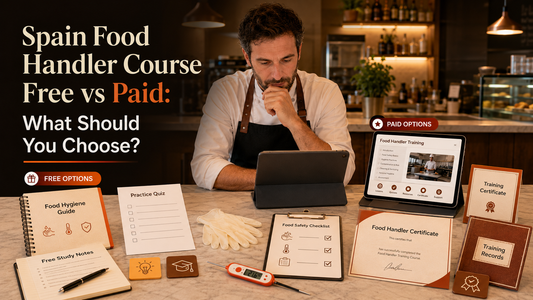
For a deeper comparison, read Spain Food Handler Course Free vs Paid: What Should You Choose?.
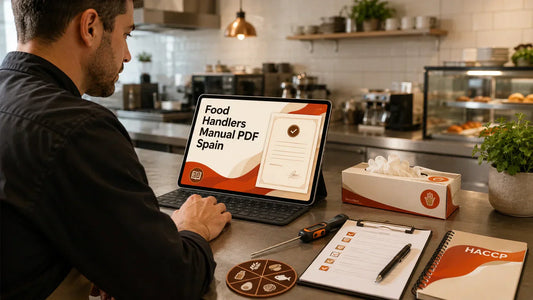
If you want a study guide before your assessment, read Food Handlers Manual PDF Spain.
English or Spanish Food Handler Training: Which Should You Choose?
Many international workers ask if food handler training in Spain must be in Spanish.
The key issue is understanding.
Training is useful only if the learner understands it well enough to use it at work. If English is stronger for the learner, English training may help them understand the rules better. If Spanish is stronger, Spanish training may be the better choice.
For local employers, Spanish certificate details may be easier to review. For international workers, English training can make the learning clearer.
The best option depends on the learner and the workplace.
A learner should not choose a language only because it sounds more official. They should choose the language that helps them understand the food safety duties connected to their role.
This is especially important for terms such as cross-contamination, allergen information, cleaning, disinfection, temperature control, and HACCP. These are not words to memorise and forget. They are ideas that need to be used during real work.
If you are searching in Spanish, you may use phrases such as manipulador de alimentos, manipulador de alimentos online, manipulador de alimentos certificado, manipulador de alimentos en inglés, or carnet manipulador de alimentos.
If you are searching in English, you may use phrases such as food handler certificate Spain, food hygiene certificate Spain, online food hygiene course Spain, food handler course, food handler test, or food handler card Spain.
The words may differ. The goal is the same: understand food safety and keep proof of training.
How Long Does a Food Handler Certificate Last?
This is another common question.
Spain does not have one simple national expiry date for an old-style government food handler card, because that old card model is no longer the current system.
Instead, training should stay current and suitable for the worker’s role.
This means refresher training may be needed when the work changes.
For example, a worker may move from serving packaged food to handling raw meat. A café may add new allergen risks to the menu. A bakery may change recipes. A food truck may start cooking on site instead of selling prepacked food. A business may change suppliers, equipment, cleaning products, or HACCP procedures.
Training may also need to be refreshed if staff forget key rules, if an inspection finds weak practice, if a complaint happens, or if a food safety incident occurs.
A certificate from years ago may not be enough if the worker no longer remembers the basics or if the job has changed.
The safer rule is simple:
Training should be refreshed when the risk, role, procedure, or knowledge need changes.
A certificate is useful evidence. But current knowledge is what protects customers.
Can You Use a Spanish Food Handler Certificate Across the EU?
A Spanish food handler certificate can be useful because many food hygiene ideas come from EU rules.
Basic hygiene, contamination control, allergen awareness, HACCP thinking, cleaning, and safe storage are important across the EU.
But this does not mean there is one automatic EU-wide certificate that every employer or authority must accept in every case.
Acceptance may depend on the employer, the country, the language, the job role, the sector, the course content, and local expectations.
A new employer may accept your certificate. They may also ask for extra training. They may want workplace-specific instruction. They may ask for training in another language.
The same idea applies inside Spain. If you move from one job to another, your general certificate may help, but your new employer still needs to explain their own procedures.
So the safe answer is this:
A Spanish food handler certificate can support your training record, but you should check with the employer or local authority before assuming it is enough for every country, job, or sector.
Does a Certificate Let You Open a Food Business?
No.
A food handler certificate shows that training was completed. It does not give permission to open a restaurant, food truck, café, bakery, catering business, market stall, street food stand, or food production site.
This is a very important point.
A certificate can support training evidence, but it does not replace business registration, tax setup, municipal permission, health registration or notification, insurance, event permission, food safety procedures, premises rules, or local checks.
Food business rules can vary depending on the city, region, location, business type, event, vehicle, premises, and food activity.
For example, a person selling street food may need more than food handler training. They may need local permission, event approval, water and waste controls, food safety documents, allergen information, and other business requirements.
So do not treat a food handler certificate as a business licence.
It is one part of preparation. It is not the whole permission process.
If you are planning to sell food from a food truck, stall, or event setup, read Street Food in Spain: Food Handling Rules Vendors Must Know in 2026.
What Employers Should Keep as Training Evidence
Food handler training is not only a worker issue. It is also an employer issue.
A food business should be able to show that workers have been trained, instructed, or supervised in a way that fits their work.
Employers may keep certificates, training records, onboarding notes, refresher records, assessment results, procedure sign-offs, or internal training logs.
The business should know who has been trained, what training they completed, when it was completed, and whether it matches the person’s role.
But records alone are not enough.
A business can have certificates in a folder and still have weak food safety if staff do not follow safe habits.
Employers should check what happens in daily work. Do staff wash hands at the right time? Do they separate raw and ready-to-eat food? Do they check allergen information? Do they report problems? Do they clean and disinfect correctly? Do they understand what to do when equipment fails?
Good employers connect training to real work. They train staff, keep evidence, supervise behaviour, correct mistakes, and make food safety part of the culture.
How to Choose the Right Online Food Handler Course
Not every online food handler course is equal.
Some courses focus only on speed. Some use outdated wording about the old food handler card. Some are copied from another country. Some ignore allergens. Some barely explain HACCP. Some make the certificate sound like a business licence.
A good online course should be clear, current, and useful.
It should explain Spain’s current training and certificate model. It should cover the main food hygiene topics. It should include a final assessment. It should give certificate evidence after completion.
It should also be easy to understand.
Food handler training should not be filled with hard legal words. Workers need clear lessons that help them make safe choices at work.
A good course should also be honest.
It should not say the certificate lets you open a food business. It should not suggest that one certificate covers every role forever. It should not make the old food handler card sound like the current government system in Spain.
Before choosing a course, ask a few simple questions.
Does it explain hygiene clearly? Does it cover contamination and cross-contamination? Does it include allergens? Does it explain cleaning and disinfection? Does it include HACCP basics? Does it help with certificate evidence? Does it match the work you will do?
If the answer is yes, the course is more likely to be useful.
Ready to document your training and handle food with more confidence in Spain? Complete online Food Handler Training in English or Spanish and keep your certificate ready for work or employer records.
Enrol Now and Get Certified →
Common Food Handler Training Mistakes
One common mistake is searching only for the old food handler card.
The phrase is still used, but Spain’s current system focuses on suitable training and certificate evidence.
Another mistake is choosing a course only because it is fast.
Fast training is not always bad, but the course still needs to teach the right topics. A quick certificate with weak learning may not help in real food work.
Another mistake is copying advice from another country.
Food handler rules are not the same everywhere. Advice about US food handler cards, local permits, Canadian certificates, or UK awards may not explain Spain correctly.
Another mistake is ignoring allergens.
Allergen mistakes can be serious. Staff should know where to check information and should never guess.
Another mistake is thinking gloves replace handwashing.
They do not. Dirty gloves can spread contamination like dirty hands.
Another mistake is thinking a clean-looking surface is always safe.
It may not be. Some surfaces need disinfection, not only cleaning.
Another mistake is thinking a certificate lasts forever in every role.
Training should stay current. If the role changes, the training may need to be refreshed.
Another mistake is thinking the certificate is the final goal.
The certificate is evidence. Safe food handling is the goal.
Food Handler Training Checklist

Before choosing food handler training in Spain, use this simple checklist.
|
Question |
Why It Matters |
|
Does the course explain Spain’s current certificate model? |
This avoids old card confusion. |
|
Is the training easy to understand? |
Training only works if the learner understands it. |
|
Does it cover personal hygiene? |
Handwashing and illness reporting are basic safety controls. |
|
Does it explain contamination? |
Food can become unsafe in different ways. |
|
Does it explain cross-contamination? |
Germs and allergens can move between food, tools, and surfaces. |
|
Does it cover temperature control? |
Time and temperature can affect food safety. |
|
Does it explain cleaning and disinfection? |
A clean-looking surface may still need disinfection. |
|
Does it include allergen awareness? |
Staff should never guess allergen information. |
|
Does it include HACCP basics? |
Workers should understand simple risk controls. |
|
Does it include a final assessment? |
The assessment checks understanding. |
|
Does it provide certificate evidence? |
Employers may need proof of training. |
|
Does it avoid false claims? |
A certificate is not a business permit. |
|
Does it fit the worker’s real role? |
Training should match the work being done. |
Continue Reading
How to Get a Food Handler Certificate in Spain
Everything You Need to Know About Food Handling
Street Food in Spain: Food Handling Rules Vendors Must Know in 2026
Food Hygiene Certificate Spain: What You Need to Know
Do You Still Need a Food Handler Card in Spain?
Spain Food Handler Test: Questions, Quiz and What to Expect
Spain Food Handler Course Free vs Paid: What Should You Choose?
Online Food Hygiene Course in Spain
Food Handlers Manual PDF Spain
Written by Marcus Delfield for the Spanish Compliance Institute — professional certification in compliance, regulation, and ethics for professionals working in Spain and across the EU.