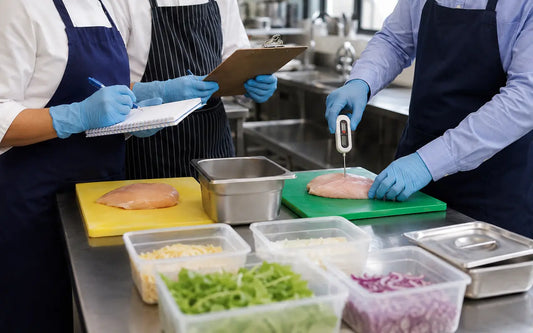
Reheating food safely means heating it rapidly until it is thoroughly hot at the centre, following the validated time-and-temperature limits in the business’s HACCP procedures. As practical guidance, many businesses use 70°C or above for a defined period. Reheat food once wherever possible, especially cooked rice and other high-risk foods.
Reheating is not simply a matter of making food warm enough to serve. The process must reduce microbiological risk without leaving the food at temperatures that allow harmful bacteria to survive or multiply.
European Union legislation does not prescribe one universal reheating temperature for every food and every business. Regulation (EC) No 852/2004 instead places primary responsibility for food safety on the food business operator and requires procedures based on Hazard Analysis and Critical Control Point principles where applicable. Businesses must therefore set, validate, monitor and document controls suitable for their products and processes. (EUR-Lex)
A food handler’s responsibility is to follow those controls accurately. This means reheating the correct portion, using suitable equipment, checking the centre of the food, recording temperatures where required and taking action if the limit is not achieved.
For a broader overview of everyday responsibilities, see Food Hygiene for Food Handlers: Practical Rules and Best Practice.
What temperature should food be reheated to?
Key takeaway: Follow the validated time-and-temperature limit in your HACCP procedures and confirm that the coldest part of the food reaches it.
A commonly used operational target is a core temperature of at least 70°C for two minutes, or an equivalent time-and-temperature combination demonstrated to achieve the required level of safety. This is practical guidance rather than a single temperature imposed universally by Regulation (EC) No 852/2004. One official food-safety guide hosted by the European Commission, for example, specifies 70°C for two minutes at the centre when reheating. (Food Safety)
A business may use a different validated limit where its product, equipment, national requirements or HACCP assessment justify it. The critical points are that reheating must:
-
Be rapid.
-
Heat the food thoroughly.
-
Reach the established limit at the coldest point.
-
Be checked using a suitable method.
-
Be followed by immediate service or controlled hot holding.
-
Be recorded when the food-safety procedure requires a record.
“Piping hot” can be a useful visual description, but it is not a reliable measurement. Steam at the surface does not prove that the centre has reached the required temperature.
Where should the temperature be checked?
Insert a clean, disinfected probe into the thickest or coldest part of the food. For a large tray, pan or batch, check more than one location because heat may be distributed unevenly.
Avoid placing the probe against:
Clean and disinfect the probe before and after use to prevent cross-contamination.

How do you reheat food safely?
Key takeaway: Reheat food quickly, check the centre and serve it immediately or move it directly into controlled hot holding.
A safe reheating process can be organised into seven steps.
-
Confirm that the food was cooled and stored safely.
Reheating cannot reliably correct serious mistakes during cooling or storage. Food left under unsafe conditions may contain high levels of bacteria or toxins.
-
Remove only the quantity needed.
Reheating smaller portions usually produces faster and more even results than repeatedly heating an entire bulk container.
-
Use suitable equipment.
Ovens, hobs, steamers and microwaves must be appropriate for the food and capable of heating it evenly.
-
Heat the food rapidly.
Avoid slow warming that leaves the product for an extended period at temperatures favourable to bacterial growth.
-
Stir, turn or divide the food where appropriate.
This reduces cold spots in soups, sauces, casseroles, rice dishes and microwave-heated foods.
-
Check the coldest point.
Use a clean, disinfected probe thermometer and compare the reading with the business’s critical limit.
-
Serve immediately or begin controlled hot holding.
Do not leave reheated food standing at room temperature.
Codex General Principles of Food Hygiene identify inadequate time-and-temperature control as a significant source of food-safety failure. The Codex framework is internationally recognised guidance and supports the use of effective process controls, although it does not replace binding EU or national legislation. (FAOHome)
Food should also be thawed correctly before reheating where the process requires full defrosting. See How to Defrost Food Safely for the appropriate methods and common mistakes.
Featured course
Basic Food Hygiene for Food Handlers
The Basic Food Hygiene for Food Handlers course covers practical food-handling responsibilities, including personal hygiene, cross-contamination prevention, temperature control and safe working practices.
Can you reheat food more than once?
Key takeaway: Reheating once is the safest and simplest operating rule because repeated cooling and reheating create additional opportunities for contamination and bacterial growth.
EU food hygiene legislation does not state a universal “once-only rule” for every type of food. However, reheating only once is widely used as professional good practice because every cycle introduces further handling, cooling, storage and temperature-control risks.
Repeated reheating may cause problems when:
-
Food cools too slowly between uses.
-
The storage time is unclear.
-
The same container is repeatedly removed and returned.
-
Staff cannot verify the full temperature history.
-
Only part of the food reaches the required temperature.
-
Quality deteriorates and staff shorten the reheating process.
-
Different batches are mixed together.
A practical business rule is to portion food before storage and reheat only the amount needed for service. Any leftovers from the reheated portion should normally be discarded in accordance with the organisation’s procedure rather than cooled and reheated again.
The once-only rule should be clearly written into staff instructions. Where a business permits a different process, it should be supported by a documented risk assessment and validated controls.
Practical scenario
A kitchen prepares ten litres of soup, cools it safely and stores it in two-litre containers. At service, one container is reheated and used. The remaining sealed containers stay refrigerated.
This is safer and easier to control than reheating the entire ten-litre batch, serving part of it, cooling the remainder and repeating the process the following day.
Why can reheating rice be dangerous?
Key takeaway: Rice becomes hazardous mainly when cooked rice is cooled or stored badly, because reheating may not destroy toxins produced by Bacillus cereus.
Uncooked rice can contain spores of Bacillus cereus. These spores may survive cooking. If cooked rice remains warm for too long or cools slowly, surviving spores can germinate and the bacteria can multiply.
Some strains can produce toxins. Reheating may kill many bacterial cells, but it may not reliably destroy toxins that have already formed. This is why reheating is not a remedy for rice that has been handled or stored incorrectly.
EFSA has assessed public-health risks associated with Bacillus cereus and related species in foods, including their ability to produce toxins and cause foodborne illness. (European Food Safety Authority)
How to handle cooked rice safely
-
Cook the rice thoroughly.
-
Serve it promptly when intended for immediate use.
-
Cool leftover rice rapidly under the business’s validated procedure.
-
Divide large quantities into smaller, shallow containers where appropriate.
-
Refrigerate without unnecessary delay.
-
Keep storage time as short as the business’s procedure requires.
-
Reheat only the amount needed.
-
Heat it rapidly and thoroughly.
-
Stir during reheating to remove cold spots.
-
Do not rely on reheating to make poorly stored rice safe.
-
Discard rice if its time-and-temperature history is uncertain.
This principle also applies to other starchy foods and prepared dishes in which spore-forming bacteria may survive cooking and multiply during poor temperature control.

How should food be reheated in a microwave?
Key takeaway: Microwave reheating requires stirring, standing time and checks in several places because microwaves commonly produce hot and cold spots.
Microwave ovens can reheat food safely, but only when the process accounts for uneven heating.
Follow these controls:
-
Use a microwave-safe container.
-
Cover the food where appropriate to retain moisture and support even heating.
-
Arrange the food in an even layer.
-
Break up dense portions.
-
Stir or rotate the food during heating.
-
Follow the equipment and product instructions.
-
Allow the stated standing time.
-
Check the temperature in several locations.
-
Continue reheating if any part remains below the required limit.
Liquids, sauces and stews should be stirred carefully because the surface may be very hot while cooler areas remain underneath.
For plated meals, check dense items separately. A hot sauce does not prove that meat, vegetables or rice beneath it are equally hot.
What happens after reheating?
Key takeaway: Reheated food must be served promptly or transferred immediately to hot holding under the business’s established temperature controls.
Once the required reheating limit has been achieved, avoid unnecessary delays. Food should move directly to service or suitable hot-holding equipment.
Hot-holding equipment is designed to maintain temperature; it should not normally be used to heat cold food slowly unless the equipment and validated procedure are specifically designed for that purpose.
During hot holding:
-
Preheat the equipment before loading it.
-
Keep containers covered where appropriate.
-
Stir foods such as sauces and soups at planned intervals.
-
Check temperatures according to the monitoring procedure.
-
Keep utensils clean and protected.
-
Avoid topping up an older batch with freshly reheated food unless the procedure specifically permits it.
-
Take corrective action when the temperature falls below the defined limit.
Corrective action may include reheating again immediately where the procedure allows it, shortening the holding period or discarding the food. Staff should not improvise when the critical limit is missed.
Featured course
Basic Food Hygiene for Food Handlers
The Basic Food Hygiene for Food Handlers course covers practical food-handling responsibilities, including personal hygiene, cross-contamination prevention, temperature control and safe working practices.
Reheating risks and controls
Key takeaway: Most reheating failures result from poor storage, slow heating, cold spots or inadequate checking.
|
Risk
|
Why it matters
|
Practical control
|
|
Food was cooled too slowly
|
Bacteria may multiply before reheating
|
Follow the validated cooling procedure
|
|
Large, dense portion
|
The centre may stay cold
|
Divide into smaller portions and check the core
|
|
Microwave cold spots
|
Some areas may remain underheated
|
Stir, rotate, allow standing time and test several points
|
|
Reheating more than once
|
Repeated handling increases uncertainty
|
Portion before storage and reheat only what is needed
|
|
Incorrect probe use
|
The reading may not represent the coldest point
|
Probe the thickest area and check multiple locations
|
|
Poorly stored rice
|
Bacillus cereus may grow or produce toxins
|
Cool rapidly, refrigerate and keep storage time controlled
|
|
Slow hot-holding equipment used for reheating
|
Food may remain too long at unsafe temperatures
|
Reheat rapidly in suitable equipment first
|
|
Missing records
|
The business cannot demonstrate control
|
Complete monitoring records accurately
|
Country variations
EU legislation establishes a common hygiene framework, but national authorities and recognised sector guides may specify particular temperatures, holding periods or monitoring practices.
Food handlers must therefore follow:
-
Their organisation’s documented HACCP limits.
-
National rules applicable in the Member State.
-
Local competent-authority guidance.
-
Manufacturer’s instructions.
-
Product-specific validated procedures.
The European Commission maintains a food hygiene guidance platform containing EU and national good-practice guides for different sectors. (Food Safety)
Reheating checklist for food handlers
Key takeaway: A short, consistent checklist helps prevent missed steps during busy service periods.
Before serving reheated food, confirm:
-
The food was cooled and stored under the correct procedure.
-
Its storage time and identity are clear.
-
Only the required quantity has been removed.
-
Suitable reheating equipment is being used.
-
The food has been heated rapidly.
-
It has been stirred or turned where necessary.
-
The coldest point meets the HACCP limit.
-
The probe was cleaned and disinfected.
-
The result was recorded where required.
-
The food will be served immediately or hot-held correctly.
-
Rice and other high-risk foods have a verified history.
-
The food has not already been reheated unless the documented procedure permits it.
For a wider daily reference, use The Food Handler’s Do’s and Don’ts.

Build safer reheating habits
Key takeaway: Training helps food handlers apply temperature controls correctly and respond consistently when a limit is missed.
Featured course
Basic Food Hygiene for Food Handlers
The Basic Food Hygiene for Food Handlers course covers practical food-handling responsibilities, including personal hygiene, cross-contamination prevention, temperature control and safe working practices.
Training does not guarantee compliance by itself. It should be supported by appropriate equipment, clear procedures, supervision, monitoring records and corrective-action instructions.
Sources and Methodology
This article was developed using binding EU food hygiene legislation, official European Commission guidance, recognised Codex standards, EFSA scientific assessments, search-intent analysis and professional food-hygiene practice.
Principal sources consulted:
This article provides general guidance rather than legal advice. National legislation, competent-authority instructions and sector-specific guidance may add requirements.