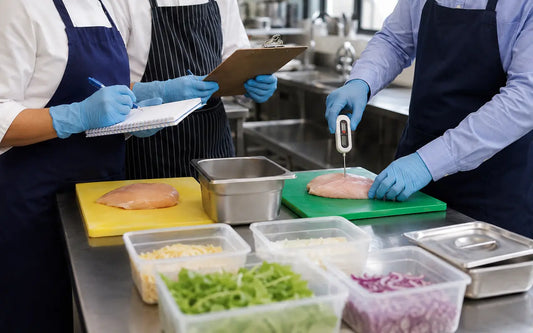
Supervisors manage allergens in a restaurant by maintaining accurate ingredient information, training staff, controlling cross-contact and ensuring that customers receive clear information. Effective allergen management connects purchasing, recipes, kitchen procedures, service and record-keeping through one consistent system.
Managing allergens is not only about adding symbols to a menu. Supervisors must make sure that ingredient information is correct, staff follow safe procedures and allergen requests are handled consistently.
Under EU food information rules, businesses must provide customers with information about regulated allergens in food, including non-prepacked dishes served in restaurants, cafés and canteens. National requirements may affect how this information must be presented.
What are the supervisor’s allergen responsibilities?
Key takeaway: Supervisors turn allergen policies into reliable daily practices.
A supervisor should ensure that allergen information is accurate and that staff know how to use it.
The main responsibilities include:
-
Checking what ingredients are used in every dish.
-
Keeping allergen information and recipes up to date.
-
Training staff according to their roles.
-
Preventing allergen cross-contact.
-
Making sure customer requests are handled correctly.
-
Recording training, checks, changes and incidents.
-
Taking corrective action when a problem is identified.
The supervisor should also make sure that allergen responsibilities are clearly divided between staff.
|
Role
|
Main responsibility
|
|
Food handler
|
Follow recipes, cleaning procedures and preparation controls
|
|
Front-of-house staff
|
Receive requests and provide approved information
|
|
Supervisor
|
Maintain the system, train staff and verify controls
|
|
Manager
|
Provide resources and approve procedures
|
For a broader explanation of the role, see the complete guide to supervising food safety.
Featured Course
Food Hygiene and Safety for Supervisors
Food Hygiene and Safety for Supervisors course covering food safety and hygiene, supervisor responsibilities, APPCC/HACCP, allergens, contamination control, inspection evidence, and a food hygiene certificate level 3..
How do you maintain accurate allergen information?
Key takeaway: Allergen information must reflect the ingredients and recipes currently being used.
Many restaurants use an allergen matrix to show which allergens are present in each menu item. The law does not require a specific document called an allergen matrix, but businesses must have accurate information available.
The information should be based on:
-
Supplier specifications.
-
Product labels and packaging.
-
Approved recipes.
-
Sauces, marinades, dressings and garnishes.
-
Cooking oils and coatings.
-
Information about possible cross-contact.
What should an allergen matrix contain?
|
Matrix field
|
What to record
|
|
Menu item
|
The name of the dish
|
|
Recipe version
|
The current approved recipe
|
|
Allergens present
|
Allergens intentionally included
|
|
Cross-contact risks
|
Relevant risks from preparation or service
|
|
Information source
|
Label, specification or recipe
|
|
Last checked
|
The most recent review date
|
|
Approved by
|
The person responsible for the review
|
The matrix should be reviewed whenever:
-
A supplier changes.
-
An ingredient is substituted.
-
A recipe changes.
-
A new dish is introduced.
-
A product label is updated.
-
Equipment or preparation methods change.
-
An allergen incident or discrepancy occurs.
Staff should never guess whether an ingredient or dish contains an allergen. When information is unavailable, the product should not be served as suitable for that customer.
A simple change-control rule is effective: no approved allergen information, no menu launch.
How should supervisors train staff?
Key takeaway: Staff must use approved information rather than memory or assumptions.
All employees who handle food or communicate with customers need allergen training appropriate to their role.
Training should cover:
-
The seriousness of food allergies and intolerances.
-
Where approved allergen information is stored.
-
The difference between ingredients and cross-contact.
-
How to receive and record an allergen request.
-
When to involve a supervisor.
-
How to communicate with the kitchen.
-
Handwashing, cleaning and utensil controls.
-
What to do when information is unclear.
-
How to report mistakes and near misses.
Role-based training
|
Staff group
|
Practical competence required
|
|
Front-of-house staff
|
Receive requests, check information and avoid guessing
|
|
Kitchen staff
|
Follow recipes and prevent cross-contact
|
|
Supervisors
|
Verify records, assess risks and resolve uncertainty
|
|
Telephone or online staff
|
Record requests and pass them on correctly
|
|
Temporary staff
|
Understand local procedures before beginning work
|
Training should include practical checks, not only a presentation or certificate. Supervisors can use observations, short questions and realistic scenarios to confirm that staff understand the procedure.
For example, if a customer asks whether a sauce contains milk, the employee should check the approved information and confirm that the current recipe has been followed. They should not answer from memory.
Training records should include:
For more guidance on building an effective training process, see how to train your food handling team.
How should staff handle allergen requests?
Key takeaway: Every allergen request should follow the same clear communication process.
A safe front-of-house procedure is:
-
Listen carefully. Allow the customer to explain the allergen or dietary requirement.
-
Confirm the request. Repeat what must be avoided and identify the relevant dish.
-
Check approved information. Use the current allergen matrix, recipe or product label.
-
Inform the supervisor and kitchen. Do not rely on an informal message passed between several employees.
-
Check preparation controls. Confirm whether shared equipment, oil, utensils or surfaces create a risk.
-
Mark the order clearly. Use the approved point-of-sale or written system.
-
Provide an honest answer. Do not make promises that cannot be supported.
-
Complete a clear handover. Confirm that the correct dish reaches the correct customer.
If the business cannot confirm that a dish is suitable, staff should explain this clearly. They should never guess or give false reassurance.
Country variations
EU rules require allergen information to be available, but individual countries may have different requirements for how the information is provided.
Businesses operating in more than one country should check the national rules in each location.
For online and distance sales, allergen information should be available before the customer completes the purchase.
Compliance note: This article provides general guidance, not legal advice. National requirements and local authority guidance may add further obligations.
How can supervisors prevent allergen cross-contact?
Key takeaway: Cross-contact controls must cover ingredients, hands, equipment, preparation areas and service.
Allergen cross-contact happens when an allergenic ingredient is unintentionally transferred to another food.
Common risk points include:
|
Risk point
|
Supervisor control
|
|
Ingredient storage
|
Label, cover and separate allergenic ingredients
|
|
Recipe preparation
|
Use only approved ingredients and substitutions
|
|
Utensils
|
Use dedicated or properly cleaned utensils
|
|
Hands and gloves
|
Require handwashing between tasks
|
|
Fryers and cooking water
|
Assess shared cooking-medium risks
|
|
Work surfaces
|
Clean surfaces effectively before preparation
|
|
Buffets and displays
|
Control utensils and monitor spills
|
|
Order handover
|
Clearly identify and separate allergen orders
|
Changing gloves alone does not remove allergens from hands, clothing, equipment or work surfaces.
Where possible, businesses should use separate equipment for allergen-controlled preparation. When this is not possible, utensils, equipment and surfaces should be cleaned effectively between uses.
Warnings such as “may contain” should not replace good allergen controls. They should only be used where a genuine cross-contact risk remains.
A supervisor’s daily allergen checklist
Key takeaway: A short daily check helps supervisors identify problems before food reaches the customer.
Before and during service, confirm that:
-
The menu matches the approved recipes.
-
Ingredient labels and supplier information are available.
-
The allergen matrix is current.
-
Staff know who is responsible for allergen requests.
-
New and temporary staff have received a briefing.
-
Clean or dedicated equipment is available.
-
Shared fryers, grills and utensils have been assessed.
-
Front-of-house staff can access approved information.
-
Allergen orders are clearly identified.
-
Online information matches the current menu.
-
Self-service areas are monitored.
-
Errors, near misses and complaints are recorded.
Supervisors should observe staff practices as well as checking documents. A complete folder does not prove that procedures are being followed during a busy service.
Lead allergen safety through effective supervision
Key takeaway: Effective allergen management depends on trained staff following a clear system.
Supervisors need enough practical knowledge to identify inaccurate information, stop unsafe substitutions, support employees and verify that allergen controls work during normal service.
The Food Hygiene and Safety for Supervisors course helps team leaders improve staff supervision, monitoring, record-keeping, corrective action and day-to-day food-safety leadership.
Featured Course
Food Hygiene and Safety for Supervisors
Food Hygiene and Safety for Supervisors course covering food safety and hygiene, supervisor responsibilities, APPCC/HACCP, allergens, contamination control, inspection evidence, and a food hygiene certificate level 3..
For more detailed information about regulated allergens and cross-contact controls, use the related specialist resource:
For deeper coverage of the regulated EU allergens, cross-contact risks and allergen controls, see our Food Allergen Awareness Training course.
Sources and Methodology
Key takeaway: This article is based on EU legislation, official guidance and recognised allergen-management good practice.
This article was prepared using:
-
Regulation (EU) No 1169/2011 on food information to consumers.
-
Commission Regulation (EU) 2021/382 on food hygiene, allergen management and food safety culture.
-
European Commission guidance on allergen information.
-
Codex Alimentarius CXC 80-2020 on food allergen management.
-
Professional good practice for food-service supervision.