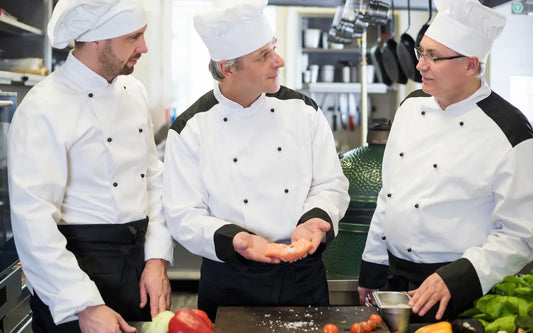
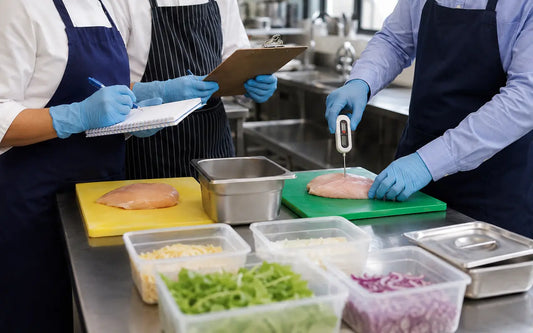
A food safety supervisor leads day-to-day food safety on the floor by training and monitoring staff, checking temperatures and records, preparing for inspections, taking corrective action and reinforcing a positive food safety culture. The role focuses on people, checks and accountability within the business’s wider food safety management system.
A food safety supervisor sits between written procedures and what actually happens during a shift. The supervisor makes sure staff understand what is expected, routine checks are completed, problems are acted on and food safety remains visible when the business becomes busy.
Under Regulation (EC) No 852/2004, food business operators must ensure that food handlers are supervised and instructed and/or trained in food hygiene matters appropriate to their work. People responsible for developing and maintaining HACCP-based procedures require adequate HACCP training. The Regulation does not prescribe one universal EU job title or a single certificate called “food safety supervisor”.
Commission Regulation (EU) 2021/382 strengthened the framework by adding explicit requirements on food safety culture, including management and employee commitment, leadership, awareness, communication and adequate resources.
For a team leader, the practical question is therefore not simply, “Do I have a certificate?” It is: Can I consistently turn the organisation’s food safety system into safe behaviour, reliable checks and appropriate action on the floor?
TL;DR: the supervisor’s role
A food safety supervisor typically:
-
briefs, trains and coaches food handlers;
-
monitors hygiene and food-handling practices;
-
checks that required temperature, cleaning and other records are completed;
-
acts when a control or check fails;
-
prepares staff and documentation for official inspections;
-
reinforces allergen, delivery, opening and closing procedures;
-
escalates serious incidents to management;
-
verifies that routine controls are being followed; and
-
helps build a positive food safety culture.
This is different from designing an entire HACCP system. For deeper system-development responsibilities.
What does a food safety supervisor do?
Key takeaway: A food safety supervisor converts the food business’s procedures into safe daily practice by supervising people, checking controls, correcting problems and maintaining evidence that required tasks have been completed.
The precise duties depend on the size and nature of the operation, but the role normally combines people supervision, operational checking, documentation and escalation.
Regulation (EC) No 852/2004 places the underlying duties on the food business operator rather than creating a harmonised EU “supervisor” title. Its training provisions require food handlers to receive supervision and instruction or training appropriate to their activities.
The European Commission’s 2022 guidance develops this further. It states that staff should be supervised and trained appropriately to their role, and that management should ensure relevant staff understand hazards, critical points, corrective measures, preventive measures, monitoring and recording procedures applicable to the business.
Core supervisor responsibilities
A practical supervisor role usually covers six connected areas:
-
People — ensuring employees know the procedures relevant to their work.
-
Checks — confirming temperatures, hygiene controls, cleaning and other required tasks are being completed.
-
Records — making sure evidence is accurate, timely and usable.
-
Problems — responding when a check fails or unsafe practice is observed.
-
Communication — passing food safety information between shifts, employees and management.
-
Follow-up — checking that corrective action actually resolved the problem.
The detailed tasks vary significantly between, for example, a small café, institutional kitchen, hotel, supermarket, food manufacturer and distribution operation.
For a deeper operational guide, see food safety monitoring and record-keeping, opening and closing checks and verification versus monitoring.
Featured Course
Food Hygiene and Safety for Supervisors
Food Hygiene and Safety for Supervisors course covering food safety and hygiene, supervisor responsibilities, APPCC/HACCP, allergens, contamination control, inspection evidence, and a food hygiene certificate level 3..
Food handler vs supervisor vs manager: what is the difference?
Key takeaway: Food handlers perform safe food-handling tasks, supervisors oversee people and routine controls, while managers normally carry broader responsibility for resources, systems, policy and organisational food safety performance.
The boundaries are not identical in every business. A small operation may combine all three roles in one person, while a larger organisation may separate operational supervisors, departmental managers, quality teams and HACCP specialists.
|
Area
|
Food Handler
|
Food Safety Supervisor
|
Food Safety Manager / System Lead
|
|
Main focus
|
Perform food-handling tasks safely
|
Supervise people and controls
|
Manage the overall system
|
|
Training
|
Understand procedures relevant to own work
|
Coach, observe and reinforce staff competence
|
Define wider training needs and resources
|
|
Routine checks
|
Complete assigned checks
|
Review completion and respond to failures
|
Analyse trends and system effectiveness
|
|
Records
|
Complete required entries
|
Check records are complete and credible
|
Define retention, review and governance arrangements
|
|
Corrective action
|
Report problems and follow instructions
|
Contain the problem and take authorised action
|
Address systemic/root-cause issues and resources
|
|
HACCP
|
Follow relevant controls
|
Monitor controls relevant to the shift
|
Develop, maintain or formally review the system where assigned
|
|
Inspections
|
Answer questions about own work
|
Prepare the operational area and records
|
Lead broader regulatory response where appropriate
|
|
Leadership
|
Follow expected behaviours
|
Reinforce safe behaviour daily
|
Set priorities, resources and organisational expectations
|
Regulation (EC) No 852/2004 specifically distinguishes ordinary food-handler supervision from the training expected of people responsible for developing and maintaining HACCP-based procedures.
Codex Alimentarius also emphasises that managers, supervisors and workers should have sufficient food-hygiene knowledge for their duties and that personnel competence should match their job activities.
The essential point is authority must match responsibility. A supervisor cannot be expected to control unsafe practice if the organisation does not give that person the authority to stop work, reject food, remove stock, request corrective action or escalate recurring failures.
For more on whether a business needs to formally assign the role, see Do You Need a Designated Food Safety Supervisor?.
Training and coaching your food handling team
Key takeaway: Effective supervision means more than sending employees on a course; supervisors need to turn training into observable competence during real work.
Training should be proportionate to the employee’s responsibilities and the risks associated with the activity.
The European Commission’s food safety management guidance makes an important practical distinction: appropriate training does not necessarily require a formal external course. Knowledge and skills may also be developed through suitable in-house training, on-the-job instruction, competent-authority information and recognised good-practice guidance. Refresher training should be considered according to business needs and demonstrated skills.
A supervisor’s training cycle
A useful approach is:
-
Induct
Before employees begin unsupervised work, explain the controls relevant to their tasks. That can include personal hygiene, contamination controls, allergen procedures, temperatures, cleaning, illness reporting and escalation.
-
Demonstrate
Show the correct procedure rather than relying only on written instructions.
-
Observe
Watch the employee perform the task under normal working conditions.
-
Correct
Address unsafe shortcuts or misunderstandings immediately and constructively.
-
Confirm competence
Check whether the employee can perform the task consistently without prompting.
-
Record where appropriate
Maintain evidence of induction, instruction, assessment and refresher activity in line with the business’s documented system and applicable national requirements.
-
Refresh
Retrain when procedures change, competence weakens, incidents occur or monitoring identifies a repeated problem.
A training certificate can support evidence of learning, but it is not a substitute for demonstrated competence.
For the full training process, including induction and training records, see How to Train Your Food Handling Team.
Businesses relying heavily on short-term workers should also establish a rapid but credible induction system. See Managing Agency and Seasonal Staff Food Safety.
Coach in the moment
Supervision is strongest when feedback happens close to the behaviour.
Instead of waiting for a formal review, a supervisor who sees poor hand hygiene, an incomplete check, incorrect storage or an allergen-communication error should intervene promptly, explain the risk and confirm the correct method.
This approach reinforces the wider food safety culture requirement because safe conduct becomes part of normal work rather than something discussed only during annual training.
Monitoring, checks and food safety records
Key takeaway: Supervisors should make sure important controls are checked at the required frequency, results are recorded accurately and deviations trigger action rather than becoming routine paperwork.
Monitoring answers a simple question: Is the control operating as expected right now?
Depending on the business, a supervisor may review:
-
refrigeration or freezer checks;
-
cooking, cooling, reheating or holding controls;
-
cleaning schedules;
-
opening and closing checks;
-
allergen controls;
-
delivery conditions;
-
stock rotation and date checks;
-
pest observations;
-
equipment condition;
-
staff hygiene;
-
corrective-action records; and
-
completion of other food safety procedures defined by the business.
The European Commission’s guidance specifically recognises monitoring and recording of relevant parameters such as temperatures and notes that verification should also occur regularly.
Records must tell the truth
A completed form is useful only if it reflects what actually happened.
Supervisors should challenge records that are:
-
completed retrospectively without justification;
-
identical every day despite normal operational variation;
-
missing corrective actions after an out-of-limit result;
-
unsigned where responsibility needs to be identifiable;
-
inconsistent with equipment readings or observations; or
-
routinely left incomplete.
Reliable records provide management with evidence about whether controls are functioning and help investigators reconstruct events when something goes wrong.
For the full list of operational record types, see Food Safety Monitoring and Record-Keeping: What to Check and Log.
Monitoring is not the same as verification
A fridge temperature check is monitoring. Reviewing several weeks of fridge records, checking that the thermometer is reliable and confirming that deviations were handled properly are examples of verification.
Codex states that food hygiene controls should be subject, where appropriate, to monitoring, corrective action, verification and documentation.
See Verification vs Monitoring: Checking That Your Food Safety System Works for the practical distinction.

Corrective action and dealing with food safety problems
Key takeaway: When something goes wrong, the supervisor’s first priorities are to control the immediate risk, protect food and customers, document what happened and prevent the same problem from becoming routine.
A failed check should never end with a number being written in a box.
Suppose a supervisor discovers a temperature deviation, evidence of pests, damaged packaging, a missed cleaning task or unsafe staff behaviour. The response normally needs four stages:
-
Contain the immediate problem.
-
Decide what to do with affected food or operations.
-
Correct the cause within the supervisor’s authority.
-
Record and escalate the issue where necessary.
Repeated problems should trigger deeper review.
For example, telling an employee to repeat a missed cleaning task may correct the immediate failure. If the same task is repeatedly missed because staffing levels make the cleaning schedule unrealistic, management may need to address the underlying resource problem.
That distinction matters because Regulation (EU) 2021/382 identifies adequate resources as one component of an appropriate food safety culture.
For practical scenarios, see Corrective Actions in Food Safety: What to Do When Something Goes Wrong.
Other incidents supervisors may have to coordinate
A team leader may also be the first person to respond to:
-
a rejected delivery;
-
an allergen information concern;
-
a supplier recall notice;
-
a customer illness complaint;
-
missing traceability information;
-
equipment failure; or
-
a significant breach of hygiene procedures.
Supervisors should know which situations they may resolve themselves and which require immediate escalation to management, the food safety system lead or a competent authority under applicable national procedures.
Preparing for a food safety inspection
Key takeaway: Inspection readiness comes from maintaining safe operations and credible records every day, not from trying to repair the system immediately before an inspector arrives.
Regulation (EU) 2017/625 provides the framework for official controls. Competent authorities are required to perform official controls on operators regularly, on a risk basis and with appropriate frequency, taking account of factors including identified risks, previous compliance and the reliability of operators’ own controls.
The supervisor’s practical role is therefore to make sure the operation is consistently capable of demonstrating control.
What should be ready?
Before an inspection, a supervisor should be able to locate or demonstrate, as relevant:
-
current food safety procedures;
-
temperature and monitoring records;
-
cleaning records;
-
staff training or competence evidence;
-
allergen information and procedures;
-
supplier and delivery information;
-
corrective-action records;
-
pest-control evidence;
-
traceability information; and
-
evidence that previous problems have been addressed.
The physical operation should also match the paperwork.
A spotless file of records will not compensate for unsafe food handling, and strong operational practice becomes harder to demonstrate if the records are incomplete.
Run routine pre-checks, not panic checks
A simple supervisor walk-through can ask:
-
Are staff following the expected hygiene procedures?
-
Are food-storage conditions satisfactory?
-
Are current checks complete?
-
Have deviations been acted on?
-
Can required records be found quickly?
-
Are allergen and food information controls working?
-
Are cleaning and maintenance issues under control?
-
Can staff explain the procedures relevant to their jobs?
For a fuller preparation process, use the Food Safety Inspection Supervisor Checklist.
Leading a positive food safety culture
Key takeaway: Supervisors shape food safety culture through the behaviours they reward, challenge, communicate and demonstrate during everyday work.
Food safety culture is not simply a motivational concept.
Commission Regulation (EU) 2021/382 added a dedicated food safety culture chapter to Regulation (EC) No 852/2004. The framework covers management and employee commitment, leadership, awareness of food safety hazards, open and clear communication and adequate resources.
Codex similarly identifies a positive food safety culture as fundamental to an effective food hygiene system and highlights commitment, leadership, awareness, communication and adequate resources.
What does culture look like on the floor?
A supervisor influences culture when they:
-
follow the rules they expect staff to follow;
-
explain why a control matters;
-
respond constructively when employees report problems;
-
stop unsafe shortcuts even during peak service;
-
recognise good practice;
-
make expectations consistent across shifts;
-
escalate resource problems instead of normalising them; and
-
use recurring failures as signals for improvement.
The European Commission’s guidance also recognises that food safety culture can be assessed through indicators and that identified weaknesses can trigger actions such as additional training, better communication or investment in resources.
Measure behaviour, not slogans
Useful supervisor-level indicators may include:
-
completion rates for critical checks;
-
repeated temperature deviations;
-
overdue corrective actions;
-
cleaning audit results;
-
recurring training gaps;
-
complaints;
-
inspection findings;
-
near misses; and
-
frequency of repeated non-conformities.
These are operational indicators, not a complete measurement of organisational culture, but they help supervisors detect patterns.

What skills and qualifications does a food safety supervisor need?
Key takeaway: EU food hygiene law focuses on appropriate supervision, training and competence rather than requiring every supervisor to hold one harmonised qualification with the same title across all Member States.
An effective supervisor normally needs competence in four areas:
1. Food hygiene knowledge
The supervisor needs enough knowledge to recognise hazards and understand the controls used in the business.
2. Operational judgement
They must know when a result is acceptable, when action is required and when the issue exceeds their authority.
3. People leadership
A technically knowledgeable supervisor who cannot communicate expectations or challenge unsafe behaviour will struggle to maintain consistent standards.
4. Documentation and follow-up
The role increasingly depends on being able to review records, identify patterns and demonstrate that corrective actions were completed.
Codex states that managers, supervisors and workers should have sufficient knowledge of food hygiene principles and practices to identify deviations and take necessary action appropriate to their duties. It also recommends periodic assessment of training effectiveness alongside routine supervision and verification.
What is Level 3 food hygiene?
“Level 3 food hygiene” is commonly used as a training description for supervisory food safety learning, but Level 3 is not a single harmonised qualification imposed by Regulation (EC) No 852/2004 across the EU.
The EU rule is outcome-focused: food handlers must receive supervision and instruction and/or training appropriate to their activities, and people responsible for developing and maintaining HACCP-based procedures must have adequate training in HACCP principles. National law may impose additional training requirements in particular sectors.
A supervisor-level course can therefore be highly useful for team leaders, but businesses should distinguish between:
-
what EU legislation requires;
-
what national or sector-specific rules require;
-
what an employer requires internally; and
-
what a particular training provider or qualification framework calls “Level 3”.
See What Is Level 3 Food Hygiene and Who Needs It? for the detailed comparison.
Country variations
Country variations: EU legislation provides the common framework, but training certificates, inspection arrangements, competent authorities and some sector-specific requirements can differ between Member States. Regulation (EC) No 852/2004 itself requires compliance with applicable national-law requirements concerning training programmes in certain food sectors.
Businesses operating in more than one country should therefore avoid assuming that a qualification, certificate or inspection practice used in one Member State automatically satisfies every local requirement elsewhere.
Food safety supervisor checklist
Key takeaway: A strong supervisor repeatedly checks people, controls, records, problems and follow-up rather than treating food safety as a once-a-day paperwork exercise.
Use this summary as a practical operating framework.
At the start of the shift
-
Confirm premises and work areas are ready.
-
Review relevant refrigeration or other control readings.
-
Check that critical equipment is functioning.
-
Confirm significant issues from the previous shift were resolved.
-
Make sure staff understand unusual risks, menu changes, allergens or operational changes.
During operations
-
Observe food handling and personal hygiene.
-
Check required monitoring is completed at the correct time.
-
Challenge unsafe shortcuts.
-
Verify allergen and cross-contact procedures are being followed.
-
Review deliveries and supplier issues where relevant.
-
Coach staff where competence gaps appear.
When something fails
-
Protect affected food and customers.
-
Take authorised corrective action.
-
Record what happened.
-
Escalate serious or repeated issues.
-
Confirm the corrective action was effective.
Before handover or closing
-
Review incomplete records.
-
Confirm cleaning and closing controls.
-
Communicate outstanding issues to the next responsible person.
-
Make sure unsafe or withdrawn stock remains controlled.
-
Record unresolved maintenance, pest, supplier or staffing concerns.
Periodically
-
Review trends in records.
-
Verify monitoring activities.
-
assess training needs;
-
review repeated corrective actions;
-
prepare for official controls;
-
monitor food safety KPIs; and
-
discuss recurring issues with management.
For printable operational detail, see Opening and Closing Checks for Food Businesses.
The overall role remains broader than one checklist. A supervisor must exercise judgement, communicate effectively and know when a problem requires management or specialist intervention.

Step up with Food Hygiene and Safety for Supervisors
Supervisors are expected to turn food safety requirements into reliable daily behaviour: training staff, monitoring controls, responding to problems, maintaining records and leading good practice.
The Food Hygiene and Safety for Supervisors course is designed for team leaders and supervisors who need practical food safety knowledge for day-to-day oversight.
Featured Course
Food Hygiene and Safety for Supervisors
Food Hygiene and Safety for Supervisors course covering food safety and hygiene, supervisor responsibilities, APPCC/HACCP, allergens, contamination control, inspection evidence, and a food hygiene certificate level 3..
Use the accompanying supervisor checklist pack to structure routine checks, coaching, corrective action and inspection preparation.
This article provides general professional guidance, not legal advice. Food businesses must assess the legislation and competent-authority requirements that apply to their activities and Member State.
Sources and Methodology
Key takeaway: This guide is based primarily on current EU legislation, European Commission implementation guidance and Codex food-hygiene principles, interpreted for the day-to-day responsibilities of supervisors.
The article uses primary legislation and authoritative guidance rather than treating commercial training terminology as law. It also separates the supervisor’s operational role from deeper HACCP-system development, which belongs with the relevant management and HACCP guidance.
Principal sources consulted:
-
Regulation (EC) No 852/2004 on the hygiene of foodstuffs, particularly Article 5 and Annex II, Chapter XII on training and supervision.
-
Commission Regulation (EU) 2021/382, amending Regulation 852/2004 in relation to allergen management, food redistribution and food safety culture.
-
European Commission Notice 2022/C 355/01 on implementation of food safety management systems, including guidance on training, Good Hygiene Practices, HACCP-based procedures and food safety culture.
-
Codex Alimentarius General Principles of Food Hygiene, CXC 1-1969, covering competence, management commitment, monitoring, verification and food safety culture.
-
Regulation (EU) 2017/625 on official controls, used for the inspection-readiness section.