Food handler training typically covers contamination and food poisoning, the 4Cs of cleaning, cooking, chilling and cross-contamination, personal hygiene, temperature control, cleaning and disinfection, allergen management, pest prevention and food-law responsibilities. Under Regulation (EC) No 852/2004, training must be appropriate to each worker’s duties and risks.
A food handler training syllabus should give workers the knowledge and practical judgement needed to handle food without creating avoidable risks. It is not simply a list of hygiene rules. Good training explains why controls matter, when they apply and what a worker should do when conditions are unsafe.
Under Chapter XII of Annex II to Regulation (EC) No 852/2004, food business operators must ensure that food handlers are supervised and instructed or trained in food hygiene matters in a way that is proportionate to their work. The legislation sets an outcome-based requirement rather than prescribing one identical course syllabus for every country, sector or job.
What Will You Learn in Food Handler Training?
Key takeaway: A complete food handler training syllabus combines essential hygiene knowledge with role-specific procedures and practical decision-making.
Most entry-level courses cover the following core subjects:
- Food contamination and food poisoning
- Cleaning, cooking, chilling and cross-contamination
- Personal hygiene and handwashing
- Safe temperature and time control
- Cleaning and disinfection
- Allergen awareness and cross-contact prevention
- Pest awareness and waste management
- Food premises, equipment and storage
- Legal duties and workplace responsibilities
- Reporting problems and following food-safety procedures
The exact depth should reflect the learner’s duties. Someone serving sealed products does not require the same technical detail as a cook handling raw poultry, a bakery worker controlling allergens or a supervisor responsible for a food-safety management system.
The European Commission’s food-safety management guidance treats training as part of a broader system of good hygiene practices, operational controls and procedures based on Hazard Analysis and Critical Control Point principles.
Country variations: Regulation (EC) No 852/2004 applies across the European Union, but Member States may use different certificate names, training frameworks, inspection expectations and sector-specific guidance. Employers should confirm any additional national or local requirements.

How Does the Syllabus Cover Contamination and Food Poisoning?
Key takeaway: Learners must understand how hazards enter food, how contamination spreads and which controls interrupt that process.
Food handler training normally begins by distinguishing three main hazard categories:
|
Hazard category
|
Typical examples
|
Main training focus
|
|
Biological
|
Harmful bacteria, viruses, parasites and moulds
|
Time, temperature, hygiene, separation and safe cooking
|
|
Chemical
|
Cleaning chemicals, allergens, pesticides and unsuitable materials
|
Correct storage, labelling, handling and cross-contact controls
|
|
Physical
|
Glass, metal, plastic, stones, hair and damaged packaging
|
Inspection, maintenance, housekeeping and reporting
|
The syllabus should explain direct contamination, indirect contamination and cross-contamination. Learners should be able to recognise how hazards move through hands, cloths, utensils, cutting boards, equipment, packaging, storage areas and food-contact surfaces.
Training should also address the conditions that allow microorganisms to survive or multiply. The purpose is not to turn every handler into a microbiologist, but to help workers understand why unsafe holding, incomplete cooking, poor chilling and delayed refrigeration can increase risk.
Codex Alimentarius describes training as fundamental to food hygiene systems and personnel competence. Its General Principles of Food Hygiene provide internationally recognised good-practice guidance, although Codex standards do not replace binding EU or national law.
Featured course
Food Handler Training | Online Food Hygiene Course
Get fully trained and job-ready in just a few hours! Learn essential food safety practices, prevent contamination, and get certified instantly to start working in any professional kitchen today.
What Personal Hygiene Topics are Included?
Key takeaway: Personal hygiene training should convert basic rules into consistent behaviours that prevent workers from contaminating food.
A typical syllabus covers:
- Effective handwashing and drying
- When hands must be washed
- Appropriate protective clothing
- Hair restraint and jewellery controls
- Cuts, wounds and waterproof dressings
- Coughing, sneezing and face-touching risks
- Eating, drinking, smoking and personal-item restrictions
- Reporting vomiting, diarrhoea, infected wounds or other relevant symptoms
- Returning to food-handling duties after illness
Handwashing training should explain both technique and timing. Washing hands at the start of a shift is not enough. Hand hygiene may be required after handling raw ingredients, using the toilet, touching waste, cleaning, handling money, using a phone or moving between incompatible tasks.
A strong course also makes clear that gloves do not replace handwashing. Gloves can become contaminated and spread hazards when workers wear them for too long or use the same pair across different activities. Food Hygiene for Food Handlers: Practical Rules and Best Practice.
How Are Temperature Control and the 4Cs Taught?
Key takeaway: Temperature training should help workers apply verified business limits rather than rely on memory, appearance or guesswork.
Many food hygiene courses organise their content around the 4Cs:
-
Cleaning: Remove food residues, dirt and harmful microorganisms from relevant surfaces.
-
Cooking: Follow validated cooking procedures so food receives an adequate heat treatment.
-
Chilling: Keep food within the storage conditions and time limits defined by the business.
-
Cross-contamination: Separate incompatible foods, equipment, people and processes.
The 4Cs are a useful teaching structure, but they are not a substitute for the business’s documented procedures. Exact cooking, cooling, reheating, delivery and storage limits may depend on the food, process, national guidance and the organisation’s food-safety management system.
Learners should be shown how to:
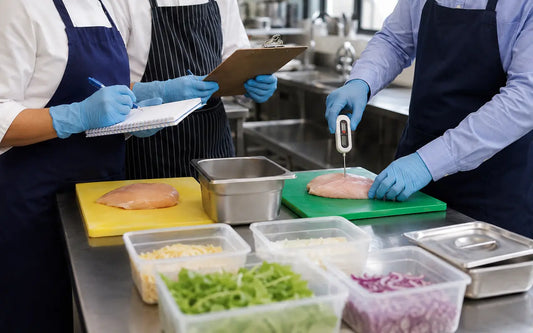
- Use the correct thermometer for the task.
- Place the probe in an appropriate part of the food.
- Clean or disinfect the probe between uses.
- Compare the result with the approved limit.
- Record the result when required.
- Take corrective action when a limit is missed.
For more detailed information, read this article: How Much Does Food Handler Training Cost? (And Free Options)

What Does the Syllabus Teach About Cleaning and Disinfection?
Key takeaway: Learners must understand that cleaning removes contamination, while disinfection reduces microorganisms after effective cleaning.
Cleaning and disinfection are related but different activities. Applying disinfectant to a visibly dirty surface may be ineffective because food residues and grease can protect microorganisms or interfere with the product.
Training should cover:
- Following the cleaning schedule
- Using the correct chemical and concentration
- Observing contact times
- Using safe water temperatures where specified
- Separating cleaning equipment by area or purpose
- Preventing chemicals from contaminating food
- Storing chemicals securely
- Cleaning difficult-to-reach equipment parts
- Reporting damaged equipment or surfaces
- Completing required records
Learners should be trained to follow the manufacturer’s instructions and the employer’s procedures rather than mixing products or estimating concentrations. The syllabus should also explain why chemicals must never be decanted into unlabelled food containers.
Pest prevention and waste control usually sit within this module. Food handlers need to recognise signs such as droppings, gnawing, damaged packaging, insects or unusual odours and report them promptly rather than attempting an unauthorised treatment.
How are Food Allergens Covered?
Key takeaway: Allergen training should address accurate information, cross-contact prevention and immediate escalation when information is uncertain.
A food handler course should introduce substances that may cause allergies or intolerances and explain the business’s allergen-control procedures. The syllabus should cover:
- Checking recipes, labels and supplier information
- Preventing substitution without authorisation
- Using dedicated or effectively cleaned equipment
- Controlling shared utensils, surfaces, oils and storage areas
- Communicating customer requests accurately
- Avoiding unsupported “allergen-free” assurances
- Escalating uncertainty to an authorised person
- Responding to suspected allergen incidents
Commission Regulation (EU) 2021/382 amended the EU hygiene framework in relation to allergen management, food redistribution and food-safety culture. European Commission guidance also states that allergens should be addressed within the food-safety management system.
Allergen awareness is not the same as clinical diagnosis or emergency medical training. The handler’s role is to follow approved controls, provide reliable information within their authority and obtain help when necessary. Managing food allergens and cross-contact.
What Food Law and Workplace Responsibilities are Taught?
Key takeaway: Food handlers should leave the course knowing both what the business must provide and what they personally must do.
Regulation (EC) No 852/2004 places primary responsibility for food safety on the food business operator. Chapter XII of Annex II requires food handlers to receive supervision, instruction or training appropriate to their activities. People responsible for developing and maintaining procedures based on HACCP principles require adequate training in those principles.
For an entry-level handler, the syllabus should translate this framework into practical responsibilities:
- Follow training and documented procedures.
- Use equipment correctly.
- Protect food from contamination.
- Complete checks and records honestly.
- Report illness, damaged equipment, pests and unsafe conditions.
- Stop and seek guidance when a control cannot be maintained.
- Cooperate with supervision and corrective action.
The course should distinguish binding legislation from official guidance and voluntary good practice. Regulation (EC) No 852/2004 and Commission Regulation (EU) 2021/382 are legally binding. European Commission notices explain implementation but do not replace the legislation. Codex principles are influential international standards and professional good practice rather than EU legislation.
How is Food Handler Training Assessed?
Key takeaway: Assessment should confirm practical understanding, not merely the learner’s ability to memorise isolated answers.
Online and classroom courses commonly use a knowledge assessment at the end of training. This may include multiple-choice questions, short scenarios, matching exercises or workplace discussions.
Assessment topics often include:
- Identifying contamination routes
- Selecting correct hygiene actions
- Recognising unsafe storage or handling
- Responding to illness or allergen questions
- Understanding cleaning steps
- Knowing when to report a problem
- Applying the organisation’s procedures
EU food-hygiene law does not establish one universal examination format, pass mark or certificate design for every Member State. This follows from its focus on training appropriate to the worker’s activity rather than a single EU-wide qualification model. National requirements, employer policies and provider arrangements may therefore differ.
A certificate records completion, but competence must also be demonstrated at work. Employers should reinforce training through supervision, observation, refresher instruction and corrective coaching.
What Should a Strong Food Handler Training Syllabus Achieve?
Key takeaway: Effective training should help workers recognise hazards, follow controls and make safe decisions during real food-handling tasks.
A reliable food handler training syllabus should be legally grounded, practical and proportionate to the learner’s role. It should explain not only what workers must do, but also why each control matters and what action to take when normal procedures fail.
Before choosing a course, check that its syllabus includes contamination, personal hygiene, temperature control, cleaning, allergens, legal responsibilities and assessment. Employers should then add workplace-specific induction covering their own equipment, products, limits, records and reporting arrangements.
For the wider certification journey, including whether a certificate is required, validity and online learning, see the complete food handler training and certification guide.

See the Full Food Handler Training Course
Key takeaway: Choose training that covers the core syllabus and can be connected directly to the learner’s actual work.
Use the course as the foundation, then reinforce it with workplace procedures, role-specific supervision and refresher instruction whenever duties, products, equipment or legal requirements change.
Training supports compliance, but it does not by itself guarantee that every national, regional or sector-specific requirement has been met.
Featured Course
Food Handler Training | Online Food Hygiene Course
Get fully trained and job-ready in just a few hours! Learn essential food safety practices, prevent contamination, and get certified instantly to start working in any professional kitchen today.
Sources and Methodology
Key takeaway: This article was developed using binding EU legislation, official European Commission guidance and recognised international food-hygiene principles.
The article applies search-intent analysis to the supplied content brief and distinguishes binding law from guidance, standards and professional good practice.
Principal Sources Consulted
This article provides general professional guidance and is not legal advice. National authorities may impose additional rules or expectations.