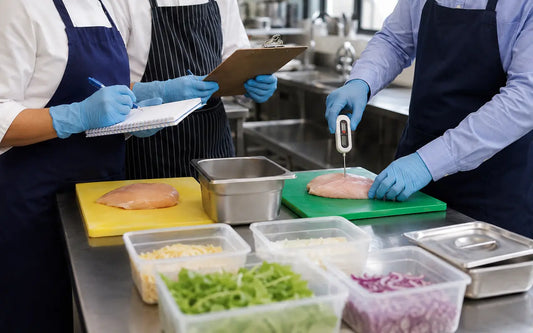
Food handler training gives people who prepare, serve, store or transport food the knowledge needed to work hygienically. Under Regulation (EC) No 852/2004, EU food businesses must ensure handlers receive supervision, instruction and/or training appropriate to their duties, although a single EU-wide certificate is not universally required.
Professional limitation: This guide provides general EU compliance information, not legal advice. Individual Member States, competent authorities and industry sectors may impose additional training or certification requirements.
Food Handler Training at a Glance
Key takeaway: EU law requires appropriate food hygiene competence, but the format, certificate name and recognition process can vary.
- Food businesses must ensure that handlers are supervised, instructed and/or trained in food hygiene in a way that matches their work.
- EU legislation does not create one universal food handler card or certificate accepted automatically in every Member State.
- Training may be delivered online, in a classroom, on the job or through a blended programme, provided it produces suitable knowledge and competence.
- Certificate validity, renewal expectations and recognised course arrangements can differ by employer, sector and country.
- People responsible for HACCP-based procedures require more advanced training than workers performing routine food-handling tasks.
- Employers should retain evidence showing what training was provided, when it was completed and whether competence was checked.
Regulation (EC) No 852/2004 establishes the binding training duty. European Commission guidance explains that appropriate training does not necessarily require formal course attendance and may also include suitable in-house instruction, technical information and recognised guides to good practice.
What Is Food Handler Training?
Key takeaway: Food handler training teaches workers how to control the hygiene risks connected with their actual duties.
Food handler training is structured instruction that helps a person handle food without creating avoidable contamination, allergen, temperature-control or hygiene risks. It should connect food-safety principles to the learner’s workplace, responsibilities and level of authority.
Basic training commonly addresses:
- Personal hygiene and illness reporting
- Biological, chemical, physical and allergen contamination
- Cross-contamination controls
- Safe storage and temperature management
- Cleaning and disinfection
- Pest awareness
- Waste handling
- Allergen management
- Food-safety responsibilities
- Corrective action and reporting
These subjects reflect the Good Hygiene Practices described in EU food-hygiene legislation and in the Codex Alimentarius General Principles of Food Hygiene. Codex is a recognised international good-practice framework rather than a replacement for binding EU or national law.
Training should not be treated as a one-off exercise in memorising rules. Its purpose is to help workers recognise hazards, follow controls consistently and respond correctly when something goes wrong.
For a detailed module-by-module breakdown, see what food handler training covers. Practical hygiene techniques should be addressed separately through [Internal link: basic food hygiene practices — planned BFH article] rather than duplicated in this certification guide.
Is a Food Handler Certificate the Same as a Food Hygiene Certificate?
In many markets, the terms food handler certificate, food hygiene certificate and food safety certificate are used for broadly similar introductory training. However, the title alone does not prove that two programmes have the same depth, assessment standard or local recognition.
The important questions are:
- Does the content match the learner’s work?
- Does it reflect applicable EU and national requirements?
- Is there a meaningful assessment?
- Does the employer or competent authority recognise the evidence?
- Is the training level suitable for the role?
The terminology is explained further in Food Handler vs Food Hygiene Certificate: Are They the Same?.

Do You Legally Need a Food Handler Certificate in the EU?
Key takeaway: EU law requires appropriate training and supervision, but it does not impose one standard certificate for every food handler.
Chapter XII of Annex II to Regulation (EC) No 852/2004 requires food business operators to ensure that food handlers are supervised and instructed and/or trained in food hygiene matters commensurate with their work. It separately requires adequate HACCP training for people responsible for developing or maintaining HACCP-based procedures. National training rules for certain sectors must also be followed.
This creates an important distinction between being trained and holding a particular certificate.
|
Question
|
EU-Level Position
|
Practical Meaning
|
|
Must food handlers be competent?
|
Yes
|
Businesses must provide suitable supervision, instruction and/or training.
|
|
Must everyone attend a formal course?
|
Not necessarily
|
European Commission guidance recognises formal, workplace and other suitable learning routes.
|
|
Is one EU certificate mandatory everywhere?
|
No
|
Certificate formats and recognition arrangements can differ nationally.
|
|
Can a certificate support compliance evidence?
|
Yes
|
A dated certificate can help demonstrate that structured training occurred.
|
|
Is a certificate enough by itself?
|
No
|
Employers must also ensure that the person can apply the learning in practice.
|
|
Do HACCP responsibilities require greater depth?
|
Yes
|
People responsible for HACCP-based procedures need adequate HACCP training.
|
European Commission guidance explicitly states that appropriate training should be viewed broadly. Skills and knowledge may be developed through formal courses, competent-authority advice, professional guidance, suitable in-house training and guides to good practice.
A recognised certificate is nevertheless useful because it creates portable, dated evidence. It can support recruitment, onboarding, inspection preparation and internal training records. It does not transfer the employer’s legal responsibility to the training provider.
A focused explanation is available in Do You Need a Food Handler Certificate?.
Featured course
Food Handler Training | Online Food Hygiene Course
Get fully trained and job-ready in just a few hours! Learn essential food safety practices, prevent contamination, and get certified instantly to start working in any professional kitchen today.
Country Variations
Country variations: Regulation (EC) No 852/2004 creates a common EU foundation, but Member States may add national requirements for particular training programmes, sectors or activities. Competent authorities may also use different inspection practices. Businesses should confirm the rules applying where the food operation is established.
The European Commission’s food-hygiene guidance platform directs businesses to EU and national guides designed for different sectors. This is especially important for activities involving products of animal origin, vulnerable consumers, mobile food operations, temporary events or sector-specific approvals.

Who Counts as a Food Handler?
Key takeaway: A food handler is anyone whose work can directly or indirectly affect food safety.
The term is wider than “chef”. A person may be a food handler when preparing food, serving open food, packing products, cleaning food-contact equipment, receiving deliveries, transporting temperature-controlled food or managing stock.
|
Role or Activity
|
Typical Training Relevance
|
Main Reason
|
|
Chef, cook, baker or kitchen assistant
|
High
|
Direct contact with open food and food-contact equipment
|
|
Butcher, fishmonger or deli worker
|
High
|
Raw products, cross-contamination and temperature risks
|
|
Server handling open food
|
Moderate to high
|
Direct service, allergen communication and contamination risk
|
|
Barista preparing drinks or food
|
Moderate to high
|
Milk handling, equipment cleaning, allergens and time control
|
|
Warehouse or delivery worker
|
Role-dependent
|
Storage conditions, damaged packaging and cold-chain controls
|
|
Retail worker handling only sealed goods
|
Often more limited
|
Lower direct-contact risk, although storage and date controls remain relevant
|
|
Cleaner in a food area
|
Role-dependent
|
Chemicals, food-contact surfaces and cross-contamination
|
|
Supervisor or manager
|
Advanced
|
Monitoring, corrective action, records and staff oversight
|
|
HACCP team member
|
Advanced
|
Hazard analysis and maintenance of HACCP-based procedures
|
|
Volunteer preparing or serving food
|
Risk-dependent
|
Occasional status does not remove the need to control food risks
|
The appropriate training should be based on the activity rather than the job title alone. A waiter who handles allergen requests may need more targeted instruction than a warehouse employee handling intact ambient products. A cleaner working around food-contact surfaces may require food-area hygiene instruction even without preparing meals.
See which food jobs require a food hygiene certificate for a role-by-role assessment. Sector-specific priorities are covered in Food Handler Training for Different Sectors.
Volunteers and community organisers should consult Food Handler Training for Volunteers and Charity Events, as occasional activities and national exemptions require careful local checking.
How Do You Get a Food Handler Certificate Online?
Key takeaway: Choose role-appropriate training, complete the learning and assessment, then retain verifiable evidence of completion.
Online food handler training can provide an efficient route to structured learning, particularly for individual learners, distributed teams, shift workers and people preparing to enter food employment. EU law focuses on suitable competence rather than prescribing one delivery format.
Step 1: Identify the Required Training Depth
Start with the learner’s actual responsibilities.
Ask:
- Will the person handle open food?
- Are high-risk or ready-to-eat foods involved?
- Will the person advise customers about allergens?
- Will the person supervise other handlers?
- Will the person maintain HACCP-based procedures?
- Does national or sector guidance name a required programme?
A basic handler course is not a substitute for supervisory, allergen-specialist or HACCP-management training.
Step 2: Check the Provider and Course
Before enrolment, review:
- Course syllabus
- Intended learner level
- Applicable regional coverage
- Assessment method
- Certificate wording
- Identity-verification arrangements
- Accessibility provisions
- Retake policy
- Record-retention process
- Employer or competent-authority acceptance
Be cautious with unsupported claims such as “universally approved”, “government accredited across Europe” or “automatically valid for life”. There is no single EU certificate-recognition system that makes every private course equivalent.
Step 3: Complete the Learning Modules
Learners should work through the complete programme rather than skipping directly to an assessment. Training is valuable only when the person understands how to apply it.
Useful programmes include scenarios involving:
- An ill employee arriving for work
- Raw food stored above ready-to-eat food
- A broken cold-storage unit
- Incorrect allergen information
- Contaminated equipment
- Cleaning chemicals near food
- Pest evidence
- A failed cooking or reheating check
Step 4: Pass the Assessment
The assessment should test understanding of the course outcomes. Many introductory programmes use multiple-choice questions, but the number of questions and pass mark are provider-specific rather than fixed by Regulation (EC) No 852/2004.
Learners preparing for an assessment can use the Food Handler Training Practice Test and Exam Questions as a revision resource.
Step 5: Download and Check the Certificate
The certificate should clearly identify:
- The learner
- The training title or level
- The provider
- The completion date
- A certificate or verification reference, where used
The learner should check that names and dates are correct before submitting the certificate to an employer.
Step 6: Record the Training
Individuals should retain a secure digital copy. Employers should record the training within their competence or learning-management system and connect it to refresher reviews.
A full purchasing and completion guide is available in How to Get a Food Handler Certificate Online.
For delivery-format decisions, compare online and classroom food hygiene training.

What Does Food Handler Training Cover?
Key takeaway: A sound syllabus covers the hazards, controls and responsibilities that food handlers must understand in their role.
A typical introductory syllabus includes the following areas:
|
Training Area
|
What the Learner Should Understand
|
|
Food-safety responsibilities
|
Why food safety matters and when concerns must be reported
|
|
Contamination
|
Biological, chemical, physical and allergen hazards
|
|
Cross-contamination
|
How hazards move between food, people, surfaces and equipment
|
|
Personal hygiene
|
Hand hygiene, protective clothing, illness reporting and behaviour
|
|
Time and temperature
|
Chilling, cooking, reheating, holding and corrective action
|
|
Cleaning and disinfection
|
Correct methods, frequencies, products and separation of chemicals
|
|
Food storage
|
Stock rotation, date controls, separation and protection
|
|
Allergens
|
Preventing cross-contact and communicating accurate information
|
|
Pest awareness
|
Recognising evidence and escalating concerns
|
|
Waste management
|
Safe containment and removal
|
|
Food-safety culture
|
Communication, responsibility, resources and consistent behaviour
|
|
Records and reporting
|
Completing checks and reporting deviations accurately
|
Commission Regulation (EU) 2021/382 amended the food-hygiene framework in relation to allergen management, food redistribution and food-safety culture. The consolidated hygiene requirements include management responsibility for ensuring suitable training and supervision and for maintaining up-to-date controls and documentation.
European Food Safety Authority consumer guidance reinforces core practices including hand hygiene, cleaning, separation of raw and cooked food, thorough cooking and safe storage. These practical controls should be taught in a way that reflects the learner’s workplace rather than as disconnected facts.
Featured course
Food Handler Training | Online Food Hygiene Course
Get fully trained and job-ready in just a few hours! Learn essential food safety practices, prevent contamination, and get certified instantly to start working in any professional kitchen today.
How Long Does Food Handler Training Take?
Key takeaway: Course duration is provider- and role-dependent; EU law does not prescribe a universal number of hours.
An introductory online food handler course may be designed for completion in one sitting or across several shorter sessions. More advanced training normally requires greater depth, workplace application and assessment.
When comparing duration, do not assume that the shortest course provides the best value. Consider whether the programme gives enough time to:
-
Explain the main hazards
- Use realistic examples
- Check understanding
- Complete a meaningful assessment
- Support learners with different experience or language needs
The legal test is not the number of hours printed on a certificate. The business must ensure that the person’s supervision, instruction and/or training are appropriate to the work performed.
Does a Food Handler Certificate Expire?
Key takeaway: EU law does not set one universal expiry date, but competence must remain current.
Regulation (EC) No 852/2004 does not state that every food handler certificate expires after a fixed number of years. However, a certificate issued years ago may no longer provide persuasive evidence that the learner understands current procedures, hazards or responsibilities.
Refresher training should be considered when:
- The employee changes duties
- New equipment or processes are introduced
- The menu or allergen profile changes
- Legislation or official guidance changes
- Monitoring identifies repeated errors
- An incident or near miss reveals a knowledge gap
- The employer’s refresher period is reached
- The competent authority or customer standard expects updated training
A three-year refresher cycle is common in some organisations and training schemes, but it should not be presented as a universal EU legal expiry rule. Businesses should set review periods according to risk, national expectations and evidence of continuing competence.
Read How Long Is a Food Hygiene Certificate Valid? for a detailed renewal framework.
A learner who cannot locate an older certificate should follow the steps in Lost Your Food Hygiene Certificate? How to Get a Replacement.
How Much Does Food Handler Training Cost?
Key takeaway: Compare suitability, recognition and support rather than choosing solely by the lowest advertised price.
There is no EU-wide statutory course fee. Prices vary according to delivery method, course depth, assessment arrangements, language options, learner support, certificate verification and the number of employees enrolled.
Paid Training
A paid course may offer:
- Structured learning content
- A formal assessment
- Downloadable evidence
- Learner support
- Progress tracking
- Employer reporting
- Certificate verification
- Regular content updates
The provider should explain clearly what is included. Additional certificate, resit or administration charges should not be hidden.
Free and Subsidised Options
Free training may be available through:
- Employers
- Public employment programmes
- Industry initiatives
- Local authorities
- Trade or professional organisations
- Internal workplace programmes
Free does not automatically mean unsuitable, and paid does not automatically mean recognised. The decisive issue is whether the training is appropriate, accurate and acceptable for the learner’s role and location.
For purchasing guidance, see How Much Does Food Handler Training Cost?.
How Can a Food Handler Certificate Support Your Career?
Key takeaway: A current certificate can strengthen an application, but employers still assess experience, suitability and practical competence.
Food handler training can help an applicant demonstrate that they understand basic hygiene responsibilities before starting work. This may be useful for roles in catering, hospitality, retail, manufacturing, education, care, healthcare support and community food services.
Common career routes include:
- Food handler or kitchen assistant
- Chef, baker, butcher, deli worker or specialist operative
- Team leader or shift supervisor
- Food-safety supervisor or quality-assurance technician
- Food-safety manager, technical manager or HACCP lead
- Auditing, consultancy or specialist compliance roles
Entry-level certification does not qualify someone automatically for a supervisory, technical or auditing position. Progression usually requires experience, role-specific instruction and more advanced training.
For a broader overview, see Food Safety Jobs: Roles, Requirements and Career Paths.
How Should You List the Certificate on a CV?
Place it under a Certifications, Training or Professional Development heading. Include:
- Certificate or course name
- Training level, where relevant
- Provider
- Completion year
- Expiry or review date, where applicable
Example:
Food Handler Training Certificate — [Provider], completed 2026
Do not describe a short introductory course as a professional licence or claim an accreditation that the provider does not hold.
See Adding a Food Hygiene Certificate to Your CV for placement examples and interview guidance.
Which Food Handler Training Level Do You Need?
Key takeaway: Training depth should follow the person’s responsibilities, not an assumed Europe-wide level-numbering system.
Terms such as “Level 1”, “Level 2” or “Level 3” are used by many training providers, but they are not a single harmonised EU qualification structure. Learners should compare outcomes rather than relying only on the number in a course title.
|
Responsibility
|
Appropriate Training Depth
|
|
Limited contact with sealed or low-risk goods
|
Basic awareness and role-specific instruction
|
|
Direct handling of open food
|
Core food handler or food hygiene training
|
|
Preparation of high-risk or ready-to-eat food
|
Detailed handler training with workplace controls
|
|
Supervision of handlers
|
Supervisory food-safety training
|
|
Allergen communication or management
|
Targeted allergen training
|
|
Development or maintenance of HACCP procedures
|
Adequate HACCP training
|
|
Management of the food-safety system
|
Advanced management, verification and compliance training
|
Chapter XII of Regulation (EC) No 852/2004 specifically distinguishes general handler training from adequate HACCP training for people responsible for HACCP-based procedures.
What Must Employers Do About Food Handler Training?
Key takeaway: Employers must identify training needs, provide appropriate learning and verify that workers apply it.
The legal duty belongs to the food business operator. Buying certificates is not enough if employees cannot follow the organisation’s controls.
A practical employer system should include the following steps:
1. Define Competence by Role
Document what each role must know and do. Separate basic awareness, food-handling competence, supervisory duties and HACCP responsibilities.
2. Train Before Unsupervised Work
New starters should not perform duties beyond their competence. Where learning is incomplete, use lawful restrictions, close supervision and documented controls.
3. Provide Workplace-Specific Instruction
A general course cannot explain every local procedure. Staff must also understand the organisation’s:
- Allergen controls
- Cleaning schedules
- Temperature limits
- Reporting routes
- Illness policy
- Stock-management procedures
- Corrective actions
- Emergency arrangements
4. Check Understanding
Use observation, questions, demonstrations, records and supervision. A certificate confirms course completion; it does not prove consistent workplace behaviour.
5. Retain Evidence
Keep proportionate records of:
- Learner name
- Role
- Training completed
- Completion date
- Assessment result
- Workplace instruction
- Refresher date
- Competence concerns
- Corrective training
6. Review After Change or Failure
Training needs should be reassessed after process changes, incidents, complaints, audit findings or repeated non-conformities.
7. Support Food-Safety Culture
Commission Regulation (EU) 2021/382 introduced food-safety-culture requirements into the hygiene framework. Management commitment includes clear responsibilities, effective controls, adequate resources, appropriate training and supervision, regulatory compliance and continual improvement where appropriate.
For a complete team-management framework, see Food Handler Training for Employers: Meeting Your Legal Duty.
Start the Right Food Handler Training
Key takeaway: Choose training that matches your duties, location and required level of responsibility.
Featured course
Food Handler Training | Online Food Hygiene Course
Get fully trained and job-ready in just a few hours! Learn essential food safety practices, prevent contamination, and get certified instantly to start working in any professional kitchen today.
Before enrolling, confirm:
- The course level matches your role
- The syllabus covers your workplace risks
- The certificate is accepted by your employer
- Any national or sector-specific requirements are addressed
- The assessment and certificate arrangements meet your needs
Sources and Methodology
Key takeaway: This guide is based on binding EU legislation, official European Commission guidance and recognised food-hygiene standards.
The article was prepared using the target search intent, supplied content-cluster requirements and the distinction between certification guidance and detailed hygiene-practice content.
Principal Sources Consulted
- Regulation (EC) No 852/2004 on the hygiene of foodstuffs, particularly Annex II, Chapter XII on training and the consolidated food-safety-culture provisions.
- Commission Regulation (EU) 2021/382, concerning allergen management, food redistribution and food-safety culture.
- European Commission Notice on food-safety management systems, including official guidance on proportionate, formal and workplace-based training.
- European Commission Food Hygiene Guidance Platform, including access to EU and national good-practice guides.
- Codex Alimentarius General Principles of Food Hygiene, CXC 1-1969, as a recognised international good-practice framework.
- European Food Safety Authority guidance on proper food handling, used to confirm core hygiene-control themes.
National rules and competent-authority expectations should be checked before relying on this guide for a specific business decision.