CPD-Accredited Courses
Money Back Guarantee
24/7 Learner Support

Food Safety & Hygiene Compliance Courses

Structured food safety training aligned with EU hygiene rules and Spanish law. Designed for kitchen staff, hospitality teams, restaurants and operations managers. Covers HACCP, kitchen safety, hygiene levels and allergen management.

  • 12k+ Active Learners
  • 120+ Spanish Courses
  • 4.8 Average Rating
Food Safety and Hygiene course collection image showing chefs preparing fresh food safely in a professional kitchen.
Certification badge
Certification badge

Food Safety & Hygiene Compliance Courses (12)

Learn at your own pace, earn recognized certifications, and stay up to date with compliance requirements.

Pest Control Training Course cover showing a worker cleaning an industrial food processing environment.

Pest Control Training Course

$23.00

  • 27
  • 83
  • Intermediate
Food safety professional inspecting a packaged food product during Food Allergen Awareness Training.

Food Allergen Awareness Training

$36.00

  • 79
  • 184
  • Intermediate
Food handler wearing an apron working at a cafe counter during HACCP for Food Handlers and Small Food Businesses.

HACCP for Food Handlers and Small Food Businesses

$42.00

  • 9
  • 24
  • Intermediate
Food hygiene and safety supervisor reviewing food handling practices and quality control measures to maintain compliance and food safety standards.

Food Hygiene and Safety for Supervisors

$48.00

  • 28
  • 73
  • Intermediate
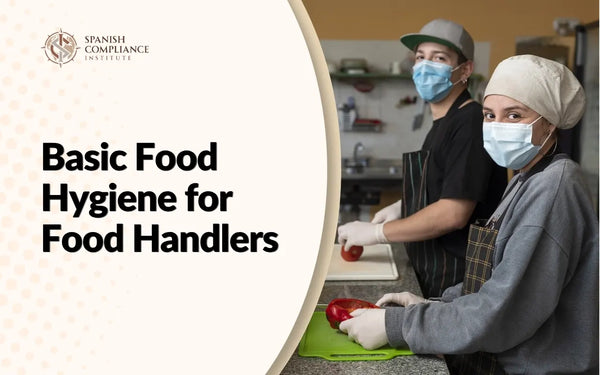
Food handlers demonstrating basic food hygiene and safety standards in a commercial kitchen, focusing on cleanliness, contamination prevention, and proper food preparation.

Basic Food Hygiene for Food Handlers

$30.00

  • 27
  • 86
  • Intermediate
Health and Safety for Food Handlers Training cover featuring a food worker in proper protective equipment.

Health and Safety for Food Handlers Training

$36.00

  • 17
  • 59
  • Intermediate

About Food Safety & Hygiene Compliance

The official food handler card was abolished in Spain by Royal Decree 109/2010 — training your staff is now the food business operator's own legal responsibility, and you must be able to evidence it.

01

Why Food Safety Training Is a Legal Requirement for Spanish Food Businesses

A widespread misconception still costs businesses money: that food handlers need an official card issued by the administration. Royal Decree 109/2010 abolished that system. Since then, the duty to train staff sits directly with the food business operator, who must be able to demonstrate to an inspector that every worker has received training appropriate to their role.

Regulation (EC) 852/2004, Annex II Chapter XII, states it plainly: the operator must ensure food handlers are supervised and instructed in food hygiene matters commensurate with their work activity. There is no exemption based on business size.

Proper food safety training helps your organisation:

  • Evidence compliance during health inspections with named, dated certificates — the first document the competent authority asks to see.
  • Avoid administrative penalties under Law 17/2011 on food safety and nutrition, where the most serious infringements reach six figures, alongside possible suspension of trading.
  • Prevent foodborne illness outbreaks through control of cross-contamination, holding temperatures, and personal hygiene practice.
  • Meet allergen obligations under Regulation (EU) 1169/2011 and RD 126/2015, which require information on all fourteen declarable substances for non-prepackaged food as well.
  • Implement and maintain the HACCP self-control system required by Article 5 of Regulation (EC) 852/2004, with staff able to apply it daily rather than simply file it.
  • Cut waste and spoilage through correct stock rotation, storage, and temperature control.
  • Protect the establishment's reputation, in a sector where a single incident of food poisoning becomes negative reviews and lost custom within days.

Whether you run a restaurant, a bakery, a school canteen, a care home, or a catering operation, training your team is your first line of defence and your documentary proof of diligence.

02

What Our Food Safety Courses Cover


Our food safety catalogue is built on the European and Spanish regulations that apply directly to the sector, running from initial food handler training through to HACCP system management for supervisors and managers. Core coverage:

  • Food hygiene fundamentals — Personal hygiene, handwashing, workwear, food handler health status, and reporting of communicable illness.
  • Food hazards — Identifying and controlling biological, chemical, physical, and allergenic hazards across the chain.
  • HACCP and self-control systems — Hazard analysis, critical control points, critical limits, monitoring, corrective action, verification, and documentary records.
  • Prerequisite programmes — Cleaning and disinfection plans, pest control, maintenance, water supply, training, traceability, and supplier control.
  • Temperature control and the cold chain — Refrigeration, freezing, reheating, hot holding, blast chilling, and food transport.
  • Cross-contamination prevention — Separating raw and ready-to-eat foods, surface and utensil use, kitchen workflow, and waste handling.
  • Allergen management — The fourteen declarable substances in Annex II of Regulation (EU) 1169/2011, consumer information for non-prepackaged food under RD 126/2015, and communication protocols between front and back of house.
  • Labelling and traceability — Mandatory information, use-by and best-before dates, batch identification, and product withdrawal capability under Regulation (EC) 178/2002.
  • Cleaning and disinfection — The difference between the two operations, product selection and dosing, documented cleaning schedules, and verification of effectiveness.
  • Anaphylaxis and emergency response — Recognising the signs of a severe allergic reaction and acting immediately, with dedicated modules for school settings.
  • Health and safety in hospitality — The occupational risks specific to kitchens and service areas: cuts, burns, slips, manual handling, and work around hot surfaces.
  • Food safety culture — The requirement introduced by Regulation (EU) 2021/382, aimed at embedding commitment to food safety across the whole team rather than in one manager.

Every course is fully online, mobile-optimised, and includes assessment and a downloadable certificate suitable for presenting to health inspectors in any autonomous community.

03

Who Needs Food Safety Training in Spain?

The obligation covers anyone handling food in the course of their work, regardless of the size of the establishment or the type of contract. Groups needing documented training:

  • Kitchen and front-of-house staff in restaurants, bars, cafés, hotels, and quick-service outlets — including temporary and seasonal workers.
  • Supervisors and site managers, who oversee handling practices, carry out internal checks, and keep the self-control system records.
  • Food business owners and sole traders, who carry ultimate legal responsibility for compliance.
  • School canteen staff and supervisors, given the food served to children and the management of allergies and intolerances in an educational setting.
  • Care home and social care staff, serving groups particularly vulnerable to foodborne infection.
  • Catering and contract catering operations, where transport and hot or cold holding multiply the risk points.
  • Bakeries, butchers, fishmongers, and delicatessens, subject to specific retail hygiene requirements.
  • Supermarket and food retail staff working on fresh produce, in-store preparation, or chilled replenishment.
  • Delivery riders and food delivery staff, responsible for maintaining temperature and packaging integrity in transit.
  • Food trucks, market stalls, and seasonal operations, held to the same requirements as a fixed premises.

If your team doesn't hold current, named certificates, your business is exposed at the next inspection.

Why Spanish Compliance Institute

We don't teach regulation for its own sake. Every course is built around what professionals and organisations operating in Spain and the EU need to actually implement — in the real world, under real obligations.

Accredited certification

Every certificate is industry-recognised and supports ongoing professional development records.

Built around Spanish & EU law

Content is designed around the specific legal framework your organisation operates under — not generic international templates.

Structured for all experience levels

From compliance officers to first-time learners — each course indicates level, duration, and prerequisites upfront.

Continuously updated content

As Spanish and EU regulations evolve, so does our curriculum. You'll always be trained on current obligations.

Frequently Asked Questions

Everything you need to know

What is the Spanish Compliance Institute?

Spanish Compliance Institute is an online learning platform offering practical compliance courses based on Spanish and EU regulations.

How are courses kept up to date?

We continuously review and update course content as Spanish and EU regulations evolve — including changes to GDPR enforcement guidance, NIS2 transposition, and the EU AI Act implementation timeline.

Are these courses suitable for beginners?

Yes. Courses are structured by level, with foundational programmes designed for those new to compliance and advanced modules tailored for compliance officers, DPOs, and senior professionals.

Are your courses accredited?

Yes. All courses are accredited and built around recognised EU regulatory frameworks and Spanish compliance standards. Certificates are accepted by employers and auditors across Spain.

How long do I have to complete a course?

All courses are fully self-paced. Most programmes range from 10 to 30 hours of study time, and your progress is saved automatically so you can learn on your own schedule.

Are the courses live and who teaches them?

Our courses are fully online, self-paced, interactive and sometimes include video lessons developed by compliance professionals.

Are there any assessments and certification?

Yes, each course includes module assessments and a final test. Learners receive an accredited certificate upon successful completion.

Do you offer discounts and refunds?

Yes - we often offer early bird discounts for learners who join early. Refunds are available based on our terms and conditions.

Do you offer corporate or team training?

Yes. We offer scalable programmes for departments and full organisations. Contact us to discuss volume access, team dashboards, and compliance reporting for your workforce.

What happens after I complete a course?

You'll receive a digital certificate upon successful completion of all assessments. Certificates are downloadable, shareable, and suitable for inclusion in professional development records.

Get started today

Start with one course or build a full compliance programme for your organisation. Self-paced, certified, and built for Spain.